

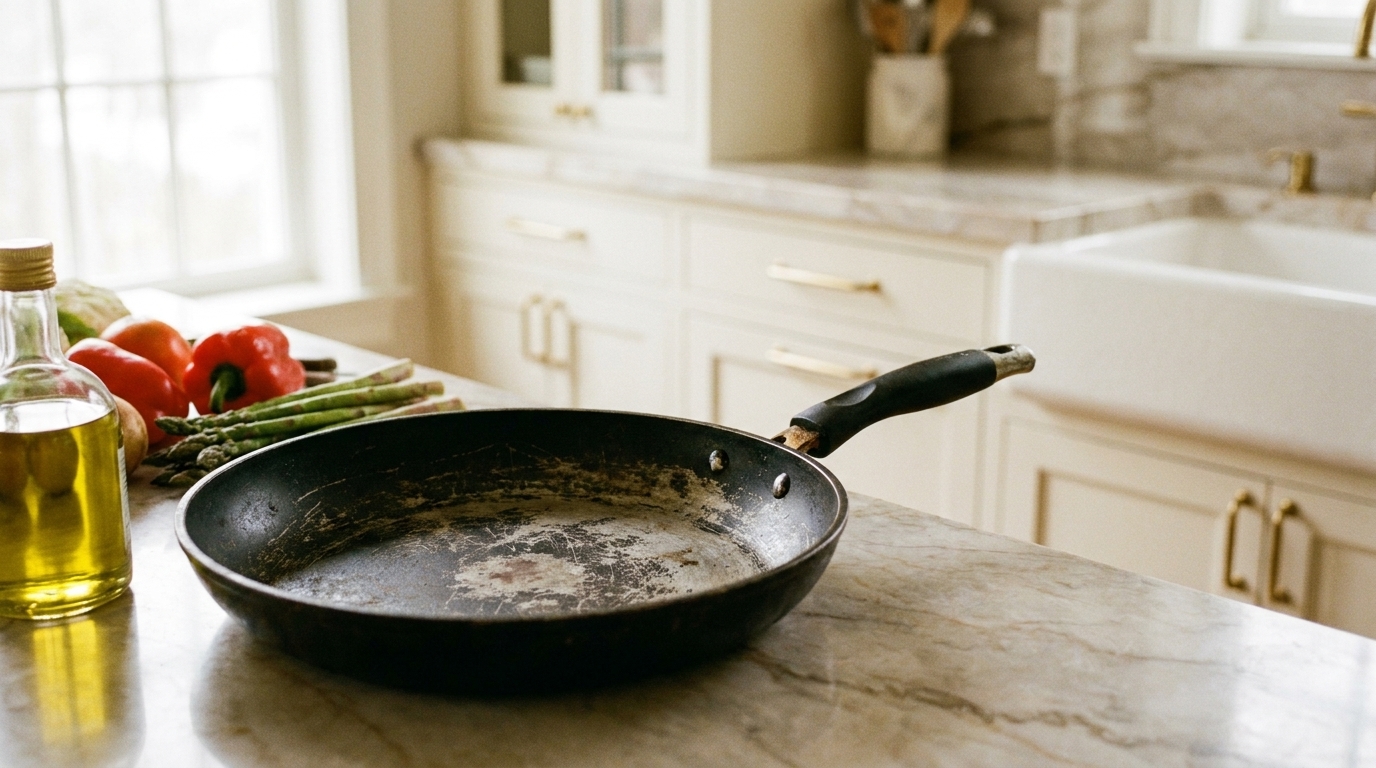
Nonstick coatings fail through a combination of heat damage, mechanical wear from utensils and cleaning, and chemical breakdown from moisture and oxygen exposure. Understanding these causes helps you extend your pan's life through proper care or recognize when replacement is necessary for safety.
Signs of Nonstick Pan Deterioration
Visible scratches, peeling, and dull spots signal your nonstick coating has failed and won't recover.
Visual indicators of coating wear
The most obvious signs that a nonstick coating is failing are visible -- scratches, peeling, flaking, and surface discoloration all indicate the coating has broken down and won't recover. [1] A surface that looks dull or uneven, or shows patches where the coating appears lifted or bubbling, signals the same problem. [1] In PTFE pans, scratches reduce coating stability and increase the risk of overheating damage at lower temperatures; in ceramic pans, scratches expose the rough base beneath, which causes sticking to accelerate quickly. [2] If you want to understand what's happening at a material level, our breakdown of PTFE coating explains what the label won't.
Changes in cooking performance
When a nonstick coating starts to fail, cooking behavior changes before the damage becomes visually obvious.
Food that previously released cleanly begins to catch and stick in specific spots -- typically the center of the pan, where heat is highest and coating wear concentrates first. [4] A pan that no longer sits flat on the burner will heat unevenly, creating hot spots that burn in one area while undercooking in another. [5] Reaching for cooking spray to compensate for increased sticking is a reliable sign the coating has degraded past the point of recovery -- and often makes the problem worse, since spray residue burns onto the surface and accelerates further breakdown. [5]
Physical damage and its impact
Physical damage does more than reduce nonstick performance -- once the coating is breached, the deterioration accelerates.
Scratches and chips expose the base material beneath, creating rough edges that catch on utensils and cause additional flaking with every use. [6] Each new scratch becomes a site where heat, moisture, and mechanical stress degrade the surrounding coating faster, meaning damage rarely stays contained to one spot. [7] More critically, a pan with a damaged coating can contaminate food with coating particles, including PFAS compounds and micro- and nanoplastics -- materials that have no place in what you're eating. [6] If that risk factors into your decision, our hands-on testing of PFAS-free nonstick pans covers options that skip the coating altogether.

Common Causes of Nonstick Pan Damage
Metal utensils, high heat, and dishwashers are the three fastest ways to strip away your nonstick coating and expose the base material underneath.
Improper utensil use and its effects
Metal utensils damage nonstick coatings because their sharp, rigid edges apply concentrated pressure to a surface that measures only 10-100 microns thick. [8] PTFE coatings scratch under that pressure; ceramic coatings chip at stress points -- either way, the base material gets exposed and sticking accelerates from there. [8] Wooden and silicone utensils avoid this entirely: wood handles high heat without deforming, and silicone flexes around pan curves without making hard-edge contact with the coating. [9] If you're weighing utensil-friendly options, our best nonstick frying pan guide covers reinforced coatings that hold up better under daily use.
Heat exposure and temperature control
PTFE coatings start to degrade at temperatures above 500 degreesF (260 degreesC), where polymer chains fragment at the molecular level and release chemical compounds into the air. [10] An empty pan can reach this threshold in just a few minutes on a standard burner -- meaning high-heat preheating without food or liquid in the pan is one of the fastest ways to shorten a nonstick coating's life. [6] Broiling is particularly damaging, since it exposes the pan surface directly to temperatures well beyond 500 degreesF from above rather than below. [10] Keeping heat at medium or below is the most effective care & maintenance habit for preserving the coating's structure over time. [6]
Cleaning methods that harm nonstick surfaces
The dishwasher is one of the most common sources of cleaning-related nonstick damage -- hot water, high-pressure jets, and harsh detergents work together to corrode and strip the coating faster than hand washing ever would. [12] Even a single cycle can cause the coating to begin peeling from the rim, and repeated use compounds that damage with each wash. [12] Abrasive tools cause the same problem through direct contact: steel wool, stiff-bristled scrub brushes, and harsh scouring pads scratch the surface and create the same pattern of accelerating degradation. [11] For everyday care & maintenance, warm water, mild dish soap, and a soft sponge remove food residue without putting the coating at risk. [11]
Why Do Nonstick Pans Go Bad Over Time?
Heat, moisture, and mechanical stress from cooking gradually break down nonstick coatings until they can no longer protect your food from particles.
Chemical breakdown of nonstick coatings
PTFE's nonstick properties come from its carbon-fluorine bonds, which weaken under sustained heat and oxygen exposure, causing polymer chains to fragment and release perfluorinated compounds. [13] Among these is perfluorooctanoic acid (PFOA), which forms during thermal decomposition and is non-biodegradable once released into the environment or food. [14] Ceramic coatings degrade differently: their silane bonding compounds break down with repeated heating, increasing surface roughness and weakening adhesion to the aluminum base beneath -- our guide to coated vs. solid ceramic cookware explains what that difference looks like in practice. [14] Both pathways reach the same endpoint: a coating that can no longer protect the pan's surface or keep particles out of your food.
Mechanical stress and repeated use
Every cooking session applies cumulative mechanical stress -- stirring, scraping, and food contact put abrasive force on a surface just a few hundred microns thick.
Taber abrasion testing shows wear increases significantly with both rising temperature and longer heating time, regardless of coating type. [14] For PTFE pans, abrasive weight loss increased over 80% at 350 degreesC compared to room-temperature tests, meaning higher heat doesn't just cause chemical breakdown -- it also reduces the coating's physical resistance to contact on every use. [14] Each session layers mechanical damage onto thermal stress until the C-F bonds in PTFE or the silane compounds in ceramic can no longer hold adhesion to the aluminum base beneath. [14]
Environmental factors affecting longevity
Beyond cooking temperatures and utensil contact, the kitchen environment itself contributes to coating breakdown through moisture, steam, and light.
Water causes hydrolytic scission -- a process where water molecules cleave polymer bonds in the coating -- and this occurs not just during washing, but continuously from steam generated while cooking. [15] Research shows roughly 60-70% of early coating damage comes from this chemical hydrolysis rather than physical scratching, meaning the coating degrades significantly before any visible wear appears. [15] Hot corrosion testing also confirms that sustained ambient humidity accelerates oxide layer formation on the aluminum substrate beneath the coating, weakening adhesion from below and causing spalling -- particularly at temperatures above 175 degreesC. [14]


Safety Concerns with Aging Nonstick Cookware
Damaged nonstick pans shed PFAS compounds linked to thyroid disruption and cancer, so replace any pan with dark discoloration, warping, flaking, or pans made before 2015.
Potential health risks of degraded coatings
When a nonstick coating degrades and sheds particles, the core concern is PFAS exposure -- synthetic compounds that accumulate in the body and resist breakdown.
A 2022 study using Raman spectroscopy found that even wooden utensils cause micro-abrasions that release PTFE microplastics and nanoplastics into food, meaning a visibly damaged pan accelerates a process that starts even with careful handling. [16] PFAS compounds, including PFOA, have been linked to thyroid hormone disruption, higher mortality from cardiovascular disease, and elevated risk of kidney and testicular cancers -- effects confirmed in long-term population studies. [17] At temperatures above 500 degreesF, degraded PTFE also releases gaseous compounds that can cause polymer fume fever, a flu-like response involving chills, fever, and respiratory distress. [18]
When to stop using a nonstick pan
The clearest signal to stop using a nonstick pan is when multiple problems appear at once: dark discoloration across the cooking surface, visible warping, coating that flakes or chips, or food that sticks even on medium heat. [19] Most nonstick pans last two to five years under normal use, and any pan manufactured before 2015 should be replaced regardless of condition -- PFOA-based coatings, phased out that year under EPA guidance, present risks that visual inspection alone can't assess. [20] If persistent sticking has made cooking frustrating, that alone is reason enough to replace the pan rather than compensate with extra oil or lower heat -- and if you're deciding what comes next, a non-toxic stainless steel pan sidesteps coating degradation entirely. [20]
Proper disposal of old nonstick cookware
Damaged PTFE-coated pans should not be donated -- the coating needs to be removed before the metal can be recycled, and standard curbside programs accept scrap metal in only about 5% of cases. [21] Several cookware brands now offer take-back programs that handle coating removal before processing, making them the most practical disposal path for PTFE pans; for anything else, a local scrap metal facility works, though calling ahead to confirm they accept coated pans is essential. [22] For context on what makes disposal so complicated: researchers at Newcastle and Birmingham universities recently demonstrated that PTFE can be broken down at room temperature using sodium metal and mechanical grinding -- a process that converts it into reusable sodium fluoride rather than sending it to landfill -- but this technology isn't yet available at a consumer scale. [23]


Extending the Life of Nonstick Pans
High-smoke-point oils like avocado and peanut oil clean away easily, while cooking sprays burn onto the coating and shorten pan life.
Best practices for daily use and care
Choosing the right fat matters more than most care & maintenance guides acknowledge.
High-smoke-point oils -- avocado, coconut, or peanut oil -- stay stable at nonstick cooking temperatures and rinse away cleanly; aerosol cooking sprays burn onto the surface at lower temperatures and leave a polymerized residue that bonds to the coating and accelerates breakdown over time. [24] Letting the pan cool fully before washing prevents thermal shock -- the rapid contraction that occurs when a hot pan hits cold water warps the aluminum base and creates heat distribution problems that concentrate wear on the coating. [24] For stubborn residue that warm soapy water won't lift, simmering two parts water to one part white vinegar in the pan for five to ten minutes dissolves the buildup without any abrasive contact. [24]
Storage techniques to prevent damage
Stacking nonstick pans without a buffer between them causes the same kind of damage as metal utensils -- the rough, uncoated underside of one pan grinds against the coating beneath with every shift in the cabinet. [25] Placing a clean kitchen towel, paper towel, or paper plate between stacked pans prevents that direct contact and extends coating life without requiring dedicated storage hardware. [25] Storing food in the pan after cooking compounds the problem -- moisture, salt, and acidity from leftovers continue attacking the coating long after the heat is off. [26] Keep pans away from abrasive materials in the cabinet, and avoid nesting them without a barrier, even temporarily. [27]
Alternative cooking methods to reduce wear
Reserving nonstick pans for low-to-medium-heat tasks -- eggs, fish, pancakes, and other delicate foods -- and routing high-heat cooking to other pan types is the most direct way to slow coating wear. [28] Searing requires temperatures above 450 degreesF, which exceeds safe operating limits for most nonstick coatings; deep frying holds oil at 350-375 degreesF for extended periods, adding sustained thermal stress that shortens coating life unnecessarily when cast iron or stainless steel handles both tasks without any trade-off. [28] Shifting those high-heat tasks to carbon steel or stainless steel also means your nonstick pan stays in lower-wear rotation, where it's actually designed to perform. [28]
- Metal utensils, high heat, and dishwashers are the primary causes of nonstick coating breakdown and accelerated damage.
- Damaged nonstick coatings shed microplastics and PFAS compounds linked to thyroid disruption and increased cancer risk.
- Roughly 60-70% of early coating damage comes from moisture and steam hydrolysis, not visible scratching.
- Replace nonstick pans showing dark discoloration, flaking, or persistent sticking--most last 2-5 years under normal use.
- Use wooden or silicone utensils, avoid preheating empty pans, hand wash with mild soap, and reserve nonstick for low-to-medium heat cooking.
- High-smoke-point oils like avocado and peanut oil preserve coatings; aerosol cooking sprays accelerate breakdown through polymerized residue.
- https://www.foodandwine.com/toxicologist-reasons-to-replace-cookware-amazon-11958504
- https://shopbirdy.com/when-to-replace-a-nonstick-pan/
- https://www.consumerreports.org/home-garden/cookware/make-your-nonstick-frying-pan-last-a1106078664/
- https://www.foodrepublic.com/1506297/mistakes-ruining-non-stick-pans/
- https://en.pfluon.com/how-do-non-stick-pans-lose-their-coating/
- https://www.sfa.gov.sg/food-safety-tips/food-risk-concerns/risk-at-a-glance/safe-practices-for-non-stick-pans
- https://www.dioro.com/blogs/news/cooking-with-non-stick-cookware-complete-guide?srsltid=AfmBOop0RWevbYvJFrYnj1IM5UOItu5S2FPtiAfRdN2yijNtZzuwMm4W
- https://lillyteak.com/can-you-use-metal-utensils-on-nonstick-pans/
- https://www.foodandwine.com/lifestyle/kitchen/five-ways-youre-damaging-your-nonstick-pans-how-stop
- https://www.foodandwine.com/nonstick-skillets-high-heat-11803742
- https://circulon.com/blogs/blog/how-to-clean-nonstick-cookware?srsltid=AfmBOor20wXjP6C73c84KR8YJGlDn5WQZ1T0oY9dWWuyMEbX02V_gSdr
- https://www.thespruce.com/how-to-clean-nonstick-pans-11800910
- https://www.sciencedirect.com/science/article/abs/pii/S1350630719316863
- https://pmc.ncbi.nlm.nih.gov/articles/PMC11324993/
- https://www.asaicookware.com/blogs/all/non-stick-cookware-coatings-degrade-heres-why?srsltid=AfmBOopJiD-dYv7b_XK4CvmJ-KQwnLqII0Qe23cVJENhj-E79s2WjnrR
- https://www.medicalnewstoday.com/articles/are-nonstick-pans-toxic
- https://everhope.care/blogs/do-non-stick-pans-cause-cancer
- https://www.perkinelmer.com/library/atl-pfas-in-your-pan.html
- https://www.tasteofhome.com/article/when-to-throw-away-non-stick-pans/
- https://www.allrecipes.com/article/nonstick-cookware-safety/
- https://earth911.com/home-garden/how-to-recycle-your-old-cookware/
- https://www.marthastewart.com/7989773/when-to-get-rid-of-old-pots-pans
- https://www.sciencedaily.com/releases/2025/11/251124094336.htm
- https://circulon.com/blogs/blog/how-to-clean-nonstick-cookware?srsltid=AfmBOopiYZGK58pqqgclE4J0uCcm3Iw6QrQr0qK_WaMrNd5gsutGM0M0
- https://www.thekitchn.com/nonstick-cookware-storage-trick-23743164
- https://www.today.com/food/7-ways-you-are-ruining-nonstick-pans-how-save-them-t104329
- https://gourmetkitchenworks.com/blogs/recipes/essential-guide-proper-use-and-storage-of-non-stick-pans-for-longevity-1
- https://www.dioro.com/blogs/news/cooking-with-non-stick-cookware-complete-guide?srsltid=AfmBOoraCfpxCrV6kHL0qWElKYQ5B3oy3hCVBPX6B4zB0E4RogYzhTX2