

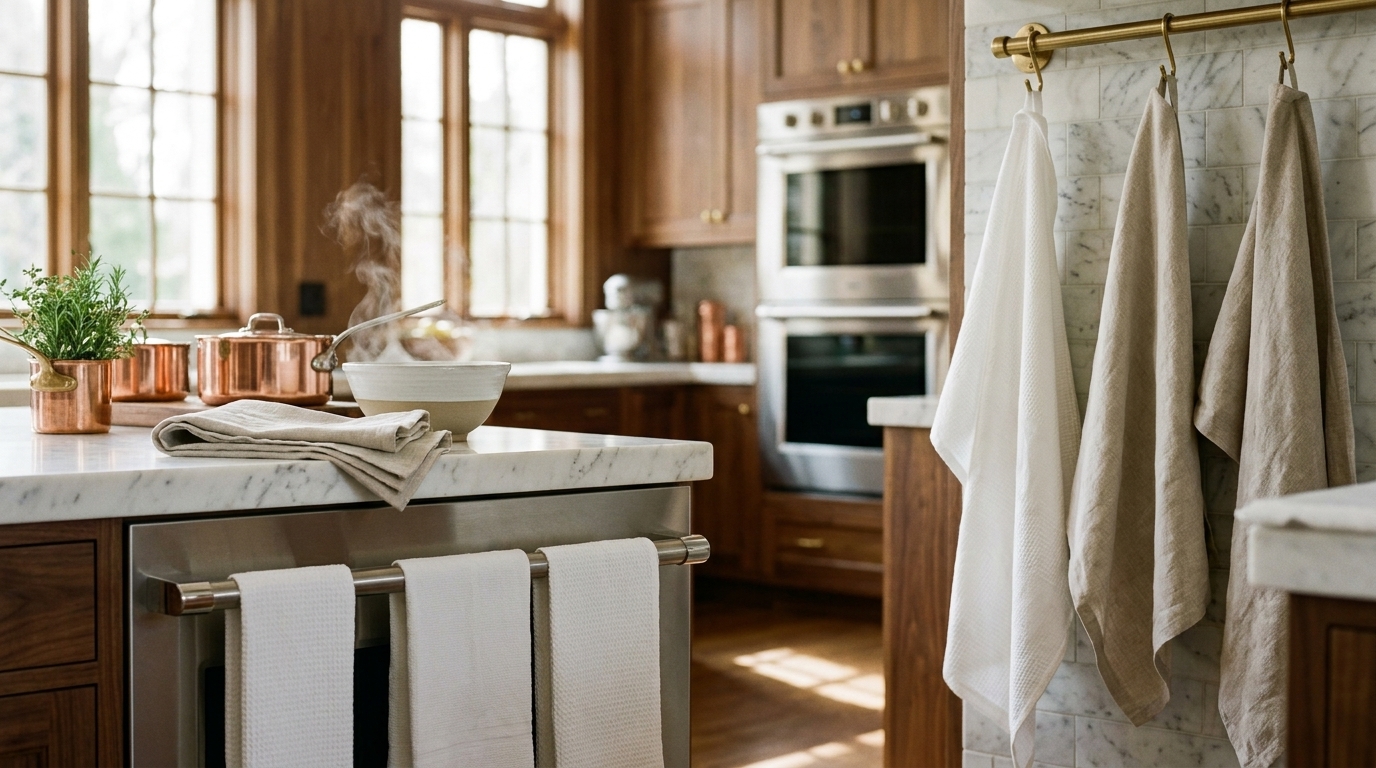
It helps you choose a kitchen towel that fits the right material and size for each cooking task and matches the care method that keeps it fresh. The right towel boosts drying efficiency, protects cookware, reduces odors and lasts longer, so you can cook with confidence.
Identify the Best Material for Your Kitchen Towels
Egyptian cotton's capillary fibers absorb moisture without streaking or scratching your cookware, and they grow softer with every wash.
Compare Cotton, Linen, and Microfiber: Absorbency, Durability, and Heat Resistance
Cotton kitchen towels are the most versatile option -- they absorb well and handle everyday tasks, though they dry slowly and can develop odors when left damp. [1] Linen absorbs moisture quickly and releases it faster than cotton, dries on the rail in a fraction of the time, and resists bacterial buildup naturally; it also becomes more absorbent with every wash rather than degrading. [1] Microfiber can hold up to seven times its weight in water and polishes surfaces without streaks, but its synthetic fibers degrade with heat exposure, which makes it unsuitable near a hot stovetop or freshly boiled cookware. [1] Most kitchens benefit from keeping all three: cotton for general use, linen for delicate glassware and baked goods, and microfiber for cold-surface cleaning only.
Why Misen's 100% Egyptian Cotton Towels outperform alternatives for delicate dishes
Egyptian cotton's extra-long staple fibers absorb water faster than standard cotton and never drag across delicate surfaces -- a real consideration when drying wine glasses, non-stick pans, or glazed ceramics. [2] Unlike synthetic microfiber, which can leave static residue or microscopic scratches on polished cookware, Egyptian cotton fibers work like tiny capillary tubes that draw moisture in rather than smearing it across the surface. [2] Our 100% Egyptian cotton kitchen towels also get noticeably softer with each wash, so performance improves over time rather than declining. [3] For cooks who invest in quality equipment, that combination of gentleness, absorbency, and long-term durability is what makes this material the practical choice over linen or microfiber for dish and cookware drying.

Match Towel Size and Design to Specific Kitchen Tasks
Choose the right towel size for each task--a 20" x 30" works best for general drying, while smaller cloths handle greasing and tea towels cover rising dough.
Select the optimal dimensions for drying, greasing, and covering cookware
The size of a kitchen towel directly affects how useful it is for a given task -- the same towel that works for drying dishes can be too bulky for greasing a pan or too small to cover rising dough.
For general-purpose drying, a 20" x 30" (50 x 75 cm) towel is the most practical choice: large enough to wrap around cookware or lay flat over multiple items, yet manageable enough to handle safely near heat. [4] Smaller dishcloths suit greasing and surface wiping, while tea towels -- designed specifically for covering baked goods and proofing dough -- typically run narrower and flatter than terry options. [5] Matching towel size to task keeps each towel cleaner between uses and lowers the risk of cross-contamination between raw ingredients and finished food.
Feature focus: Misen's reinforced loop and anti‑slip edge for easy hanging
A hanging loop on a kitchen towel isn't decorative -- it solves a real storage problem.
Without one, towels draped over a single hook shift their center of gravity unevenly and slide off, especially when damp. [7] Our kitchen towels include a reinforced cotton loop stitched beneath the hem seam for lasting durability, paired with an anti-slip edge that keeps the towel stable on hooks or oven handles without bunching or slipping mid-task.
The attachment method matters: loops tacked on loosely pull free after repeated washing, while anchoring the loop under the hem distributes tension across a wider point in the fabric, extending the life of both the loop and the towel. [6]
Maintain Kitchen Towels for Maximum Lifespan
Wash cotton towels in 60-degree water with white vinegar, skip fabric softener, air-dry in sunlight, and assign separate towels by task to keep them fresh and absorbent for years.
Step‑by‑step cleaning routine: washing temperature, vinegar sanitizing, and drying tips
Wash cotton kitchen towels separately in hot water -- 60 degreesC is the recommended temperature for breaking down grease and reducing bacterial load. [8] Skip fabric softener entirely; most formulas contain silicone oil that coats cotton fibers, reducing absorbency and creating conditions where bacteria thrive. [8] Adding a quarter to half cup of white vinegar to the wash cycle removes soap residue, restores absorbency, and disinfects dishcloths by neutralizing odor-causing bacteria -- no pre-soaking required, though soaking for 30 to 60 minutes before washing tackles heavier buildup. [8] Air-dry towels rather than machine-drying: sunlight helps clear remaining bacteria, and skipping the dryer meaningfully extends fiber life over time. [8]
Prevent stains and odors: how Misen's care guide keeps towels fresh after heavy use
Stains and odors accumulate fastest when one kitchen towel handles grease, raw proteins, and clean dishes in the same session. [10] Assign separate towels by task -- one for drying dishes, one for wiping surfaces, one for raw ingredients -- and retire any towel that contacts raw meat immediately rather than rinsing and reusing it. [9] Hanging towels flat in a ventilated spot between uses prevents the moisture buildup that feeds odor-causing bacteria; a balled-up damp towel left near the sink will smell by morning. [9] Our care & maintenance tips also recommend paper towels for high-grease tasks like blotting bacon or soaking up cooking oil -- those jobs degrade fabric faster than any wash cycle can reverse. [9]


Decision Toolkit: Quick‑Reference Comparison Table & Printable Checklist
Compare material, size, care requirements, and best uses across five towel types to find the right match for your kitchen tasks in under two minutes.
Side‑by‑side table of material, size, price, and care requirements (including Misen's product specs)
The table below covers the four variables that matter most when choosing kitchen towels: material, dimensions, approximate price per towel, and care method. Standard cotton kitchen towels -- including 100% Egyptian cotton options like ours -- run approximately 20" x 30", the size that handles dish drying and surface work without being difficult to manage. [11] Bar mops are smaller (around 15-17 inches square after washing) and cheaper per unit, while flour sack towels run larger (up to 33" x 38") and suit food prep and glassware over heavy spills. [11] Microfiber requires cold or warm washing, no fabric softener, and air drying to preserve fiber structure -- different care from cotton or linen. [13]
| Material | Size | Approx. Price/Towel | Wash Temp | Dry Method | Best Task |
|---|---|---|---|---|---|
| 100% Egyptian cotton (Misen) | 20" x 30" | See site | Hot (60 degreesC) | Air dry or tumble dry low | Dishes, delicate cookware, glassware |
| Standard cotton / terry bar mop | 15-17" sq. | ~$2 | Hot | Tumble dry | Spills, general cleanup |
| Flour sack cotton | 33" x 38" | ~$3-5 | Warm | Air dry | Glassware, food prep, straining |
| Linen | 20"-28" | ~$7-15 | Cold/warm, gentle cycle | Air dry | Glassware, baked goods, proofing |
| Microfiber | Varies | ~$3-6 | Cold or warm, no softener | Air dry only | Cold-surface polishing, dust removal |
Downloadable 5‑point checklist to verify you've chosen the right kitchen towels for 2026
Before committing to a set of kitchen towels, run through five variables that determine whether a towel will actually hold up in daily use: material type, size, construction details, care requirements, and task assignment. Each point maps directly to a decision covered in this guide -- working through them takes under two minutes and catches the most common mismatches, like choosing microfiber for stovetop tasks or a small dishcloth for covering proofing dough. Use the checklist below to confirm your choice before buying. [14]
- Material: Choose cotton or linen for any task involving food contact; reserve microfiber for cold-surface polishing only. [14]
- Size: Confirm 20" x 30" (50 x 75 cm) for dish drying; use smaller cloths for greasing pans and wiping surfaces. [15]
- Construction: Check that the hanging loop is anchored under the hem seam -- not tacked on loosely -- to prevent it from pulling free after repeated washing. [15]
- Care compatibility: Verify the towel tolerates hot washing (60 degreesC), no fabric softener, and air drying without losing absorbency or shape. [15]
- Task assignment: Plan for at least three separate towels -- one for drying dishes, one for wiping surfaces, one for raw ingredients -- before you finalize your purchase. [14]
- Choose cotton for general use, linen for delicate glassware and baked goods, and microfiber only for cold‑surface polishing.
- Egyptian cotton's extra‑long staple fibers absorb water faster, soften with each wash, and won't scratch delicate cookware.
- For dish drying, a 20" x 30" (50 x 75 cm) towel balances coverage and handling; use smaller cloths for greasing and tea towels for proofing.
- Wash cotton towels alone in 60 degreesC water, skip fabric softener, and add ¼-½ cup white vinegar to restore absorbency and disinfect.
- Air‑dry towels in sunlight rather than using a dryer; UV light reduces bacteria and prolongs fiber life.
- Assign separate towels for drying dishes, wiping surfaces, and handling raw meat; retire a towel after raw‑meat contact.
- Ensure the hanging loop is sewn under the hem seam, not merely tacked on, to prevent pulling free after repeated washes.
- https://mgctowels.com/kitchen-towel-fabric/
- https://www.towelogy.co.uk/blogs/news/the-science-behind-super-absorbent-towels-microfibers-bamboo-and-egyptian-cotton-compared?srsltid=AfmBOoqIEHbwq8cJUcqqGjyWPCsdBONB5AYI7dR-EogDqxk6JfwB_-jM
- https://www.pureparima.com/blogs/egyptian-cotton-bedding/cotton-vs-microfiber-towels
- https://www.theloomia.com/blogs/learn/towel-sizes-guide-every-type-of-towel?srsltid=AfmBOooZn8NeehtqNowe4I37Ek6anoaYWn93tU347G4Hs0L-G1TM5Cam
- https://www.towelogy.co.uk/blogs/news/the-ultimate-kitchen-towel-size-guide?srsltid=AfmBOopKhp-PXsf6selOdTx0XWcvOCbo1MmzTS2IfiDIdC05jCE_mRf4
- https://www.thekitchn.com/how-to-sew-loops-onto-dishtowels-cooking-lessons-from-the-kitchn-207288
- https://lifetips.alibaba.com/kitchen-hacks/kitchen-towel-hooks-no-slip-hanging-guide
- https://www.americastestkitchen.com/articles/3318-how-to-make-kitchen-towels-look-new-again
- https://www.thefrugalgirl.com/8-ways-to-keep-kitchen-towels-dishcloths-sanitary/
- https://www.towelogy.co.uk/blogs/news/why-kitchen-towels-smell-bad?srsltid=AfmBOor3c8rTK0RP7W0H0T1UzWTK27DV4eyItZq6XTG6Zzr2yB2Y6w1D
- https://www.nytimes.com/wirecutter/reviews/best-kitchen-towels/
- https://www.foodandwine.com/best-kitchen-towels-8720753
- https://www.bhg.com/best-kitchen-towels-6743395
- https://fergusonsirishlinen.com/es-es/blogs/blog/a-guide-to-buying-kitchen-towels-the-only-one-that-helps-you?srsltid=AfmBOopK9ZBS57hPbZz6fLsMh7xFL8zSoi0LvN_6NhbBO7K9LE8vlTYq
- https://towelhub.com/blog/what-should-i-look-for-when-buying-kitchen-towels/?srsltid=AfmBOop6d4UuRhwt0ZSNIs8yJKYWTz7LMZ3dFf46nDfDWj7jF7Ulx8cW