

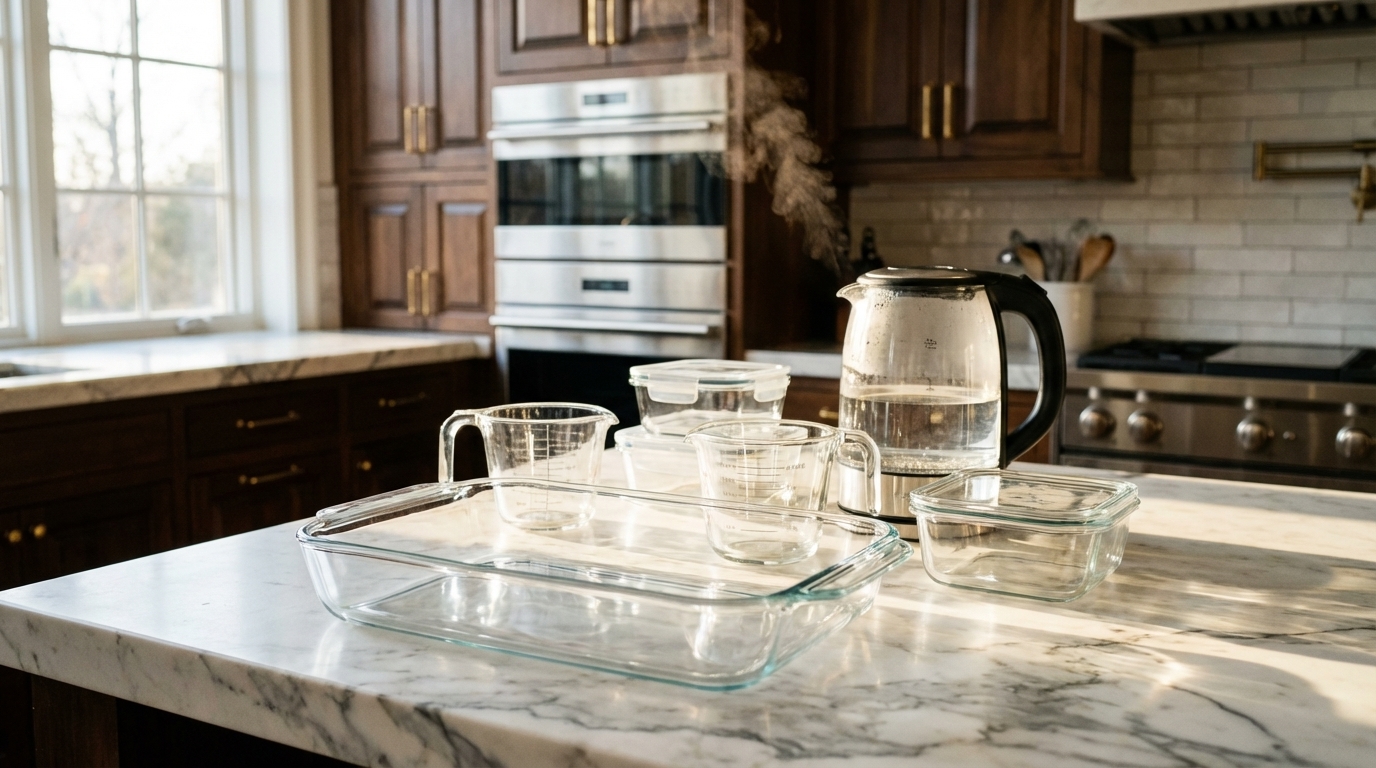
Borosilicate glass is the lab-tested kitchen workhorse that outperforms everyday soda-lime and lead crystal by releasing 50 times less sodium into acidic foods, resisting flaking unless you hit industrial-strength pH 11, and shrugging off 170 degreesC temperature swings without cracking thanks to its ultra-low thermal expansion. Because its sodium is chemically locked into the boron-rich network, it forms virtually no altered surface layer even after three years in 4 % acetic acid at 70 degreesC, a stability that satisfies both FDA and EU migration limits and makes it effectively inert--no BPA, lead, cadmium, odor absorption, or taste transfer. The article shows you how to keep that advantage intact: avoid sudden hot-to-cold shocks by using trivets, letting frozen pieces warm for 10-15 min, and retiring any chipped or scratched items, while washing gently to prevent the surface damage that concentrates stress. When shopping, look for ISO 9001, FDA/LFGB compliance, and ASTM C149 thermal-shock certification on both the glass and its platinum-cured silicone accessories, and verify the manufacturer--not just the reseller--through the IAF CertSearch database. Though borosilicate costs more upfront, its decades-long lifespan, perfect recyclability, and immunity to acidic foods make it cheaper and greener over time, giving cooks a safe, flavor-neutral, nearly unbreakable alternative to plastics or tempered soda-lime bakeware.
Understanding Borosilicate Glass Safety
Borosilicate glass keeps your food safe because its ultra-tight molecular structure releases sodium 50 times slower than lead crystal, won't flake under normal cooking conditions, and never leaches BPA, lead, or odors into what you eat.
Chemical Inertness and Food Contact
Here's what makes borosilicate glass so chemically stable: it contains boron trioxide (B₂O₃, 7-13 wt%) combined with high silica content (70-80 wt%), creating an incredibly dense molecular structure that water molecules can barely penetrate. [1] This matters in your kitchen because glass typically releases minerals through a process called ion exchange -- water slowly pulls out alkali ions (like sodium) and replaces them with protons, gradually wearing down the surface. Borosilicate's tightly packed structure puts the brakes on this breakdown. Researchers tested this by soaking borosilicate in 4% acetic acid at 70 degreesC for three years -- conditions that mimic storing tomato sauce or vinegar-based marinades.
The glass released sodium at just 2 x 10⁻³ µm/day, about 50 times slower than lead crystal glass, with zero surface damage after the entire test. [2] Another concern with glass is flaking -- when dissolved minerals from the glass reform as visible particles in your food. Korean researchers discovered that borosilicate only flakes under extreme conditions: temperatures above 100 degreesC combined with pH 11 (think industrial-strength cleaners). Standard soda-lime glass?
It starts flaking at just 90 degreesC and pH 8, conditions you might hit making pasta sauce. [3] Since your kitchen rarely sees those extreme pH levels, borosilicate stays completely stable during normal cooking and storage. It contains no BPA, phthalates, lead, or cadmium, and its molecular stability means it neither absorbs food odors and flavors nor releases anything into what you're storing or cooking. [1]
Thermal Shock Resistance in Everyday Use
The science of glass breakage comes down to uneven expansion: when one part of your glass heats faster than another, the layers expand at different rates and create stress that eventually cracks the material.
Borosilicate handles these temperature swings because it barely expands when heated -- its thermal expansion coefficient is just 3.3 x 10⁻⁶ per degreesC, about one-third that of regular glass. [4] In your kitchen, that translates to serious durability: borosilicate can handle temperature jumps of 170 degreesC without cracking, while standard glass breaks at just 40 degreesC changes. [4] Those temperature limits explain why glass breaks during everyday cooking moments -- moving a hot baking dish to a cold granite counter, or pouring boiling water into a glass fresh from the fridge. [1] Previous chips or scratches make these scenarios even riskier, since surface damage creates weak points where stress concentrates. [4] Worth noting: many glass baking dishes sold in the US now use tempered soda-lime glass rather than borosilicate, despite their heat-safe marketing.
For consistent thermal performance, look for products specifically labeled as borosilicate glass, or consider alternatives like our stainless steel cookware that handle temperature extremes without the risk of shattering. [4]
Regulatory Backing and Lab Test Results
Borosilicate glass sails through both FDA and EU food-contact rules--no extra approvals needed--because its tight silica-boron network leaches essentially nothing, even when acidic food simulants attack it for years.
FDA & EU Approvals Explained
Both the FDA and the European Commission regulate food contact materials by evaluating whether a material's components can migrate into food at levels that pose health risks -- not by approving whole materials wholesale.
In the US, a food contact material is considered compliant when each of its components either qualifies as Generally Recognized As Safe (GRAS) under 21 CFR 182-186, is listed as an approved indirect additive under 21 CFR 174-179, holds prior sanction status, falls below the threshold of regulation (0.5 ppb migration), or is covered by an effective Food Contact Substance Notification (FCN). [5] Silica and boron trioxide -- the primary components of borosilicate glass -- meet these criteria, which is why borosilicate glassware can legally enter the US food contact market without additional premarket review. [1] In the EU, the governing framework is Regulation (EC) No 1935/2004, which requires that all food contact materials -- glass included -- be manufactured under Good Manufacturing Practices (GMP) per Commission Regulation (EC) No 2023/2006, and that they not release substances into food in quantities that could endanger health, alter food composition, or change its taste or smell. [6] The practical effect of both frameworks is the same: borosilicate glass qualifies because its chemically dense network simply doesn't release components at levels either jurisdiction considers actionable.
Key Lab Findings on Leaching and Toxicity
What sets borosilicate apart from other glass types isn't just how little it leaches -- it's *how* it breaks down. In a three-year comparative leaching study, researchers altered borosilicate alongside lead crystal, soda-lime, and barium glass under identical conditions: 4% acetic acid at 70 degreesC, closely mimicking acidic food and beverage contact. [7] Lead crystal formed a thick, chemically complex alteration layer -- up to 7 micrometers deep after just 231 days -- as sodium and potassium leached out and the silicate network repolymerized around retained lead. [7] Borosilicate formed almost no such layer.
After three full years, scanning electron microscopy detected no residual altered layer at the surface, and Time-of-Flight Secondary Ion Mass Spectrometry showed a hydrated zone of only about 40 nanometers after 231 days -- the shallowest alteration depth of any glass tested. [7] The reason traces back to sodium's role in the glass structure. In lead crystal and soda-lime glass, sodium acts as a network modifier, sitting loosely in the glass matrix and exchanging readily with protons from the surrounding solution.
In borosilicate, sodium instead compensates the charge of tetrahedral aluminum and boron units, locking it into the network and drastically reducing how much exchanges into solution. [7] This also means borosilicate doesn't pass through the interdiffusion-dominated alteration stage that drives most ion migration in other glasses -- instead, its dissolution is congruent, meaning all elements release at similar rates as the network hydrolyzes uniformly, rather than layer by layer. [7] Separate toxicity testing using the EPA's Toxicity Characteristic Leaching Procedure confirmed this stability extends to modified formulations: ZnO-doped antibacterial borosilicate glass released zinc at levels below US EPA maximum limits in standardized leach testing, and researchers classified both the glass and glass-ceramic variants as harmless to human health. [7]
Practical Kitchen Tips for Safe Use
Protect your borosilicate glass from shattering by using trivets, avoiding sudden temperature swings, checking for chips before each use, and handling it by the base--not the rim.
Avoiding Thermal Shock and Breakage
As we covered earlier, borosilicate can handle temperature changes up to 170 degreesC -- but that doesn't mean you should test those limits. The kitchen moves that break glass are predictable: hot dish meets cold countertop, frozen container goes straight to hot oven.
Consumer Reports proved this dramatically when they watched glass shatter instantly after placing it hot from the oven onto a wet granite surface. [8] Here's what actually matters in your kitchen: always use a trivet or dry towel under hot glass. Let frozen pieces sit out for 10-15 minutes before heating. [9] And remember -- borosilicate excels at heat resistance, not drop resistance.
A fall from counter height onto tile will crack it just like any glass. [9] Think of it this way: gradual temperature changes are your friend, sudden ones are not.
Cleaning, Inspection, and Maintenance Best Practices
Before you even think about washing, give your glass a quick once-over. Look for chips along the rim, deep scratches, or any visible cracks -- these weak points concentrate stress and make breakage more likely, as Consumer Reports found. [10] If you spot damage, it's time to retire that piece. No amount of careful handling fixes compromised glass.
For daily care, stick with warm water and mild soap. Use a bottle brush to reach narrow spots, and if your glassware has silicone sleeves (like our roasting pan accessories), pop them off to wash separately. [11] Skip the abrasive scrubbers -- they create the exact surface damage you're trying to avoid. Got stubborn stains?
Soak first, then use a soft sponge. [11] Storage matters too: separate pieces with shelf liners or cloth to prevent chips from contact. Always grip by the base when handling, not the rim where most damage starts. [11] These simple habits mean your borosilicate keeps performing safely for years, not months.
Choosing Quality Borosilicate Products
Verify a borosilicate brand's worth by demanding its ISO 9001 certificate, LFGB-compliant glass and platinum-cured silicone, plus an ASTM C148 polariscope report--then divide the higher price across decades of thermal-shock-proof, scratch-proof performance that outlasts cheap glass.
What to Look for in Reputable Brands
When shopping for borosilicate glass, certifications tell you more than any marketing copy. Three certifications matter most: ISO 9001 shows the manufacturer runs a documented quality system (not just a one-time test), FDA or LFGB compliance confirms safe heavy metal levels, and ASTM C149 proves actual thermal shock resistance. [12] [13] LFGB deserves special attention -- it's the German standard that's stricter than FDA, testing for more chemicals and even checking if the glass affects food taste or smell. When brands meet LFGB voluntarily in the US market, they're holding themselves to a higher standard. [13] Here's what many shoppers miss: those silicone lids and seals need the same safety testing as the glass.
Quality manufacturers use platinum-cured silicone to meet strict BPA and plasticizer limits -- regular silicone won't cut it. [13] Want to verify a brand's claims? Check their ISO 9001 certificate on the IAF CertSearch database. Look for the manufacturer's full legal name and make sure the scope says "manufacturing," not just "sales" -- otherwise you're dealing with a reseller. [13] For the ultimate quality check, ask for an ASTM C148 polariscope test report.
This proves they've properly annealed (controlled cooling) their glass to prevent stress fractures. No report? They probably haven't tested. [13] The same attention to quality that matters in glass applies to all your cookware -- whether you're choosing
Balancing Cost, Durability, and Sustainability
Yes, borosilicate costs more upfront -- those 1600 degreesC melting temperatures require serious manufacturing equipment compared to regular glass at 1400 degreesC. [14] But here's the real math: divide that price by years of use instead of comparing sticker prices. Borosilicate handles the daily abuse of hot-to-cold transitions, resists scratches, and won't slowly break down from acidic foods like cheaper glass does.
One good piece often outlasts several cheap ones. [15] The sustainability story makes even more sense. Fewer replacements mean less waste, and unlike plastic that degrades each time it's recycled, borosilicate glass recycles perfectly without losing quality. [16] Smart manufacturers are already using recycled glass in production and upgrading to efficient furnaces, making that higher melting point less of an environmental concern. [16] The market gets it -- demand for sustainable glass products jumped over 25% in five years, with younger buyers especially willing to pay for materials that last. [16] It's the same principle behind investing in quality kitchen tools: the right piece bought once beats replacing cheap versions repeatedly.
Bottom Line: Safe, Affordable, Long‑Lasting Borosilicate Glass
Borosilicate glass gives you lab-grade safety, everyday affordability, and a lifetime of use--no microplastics, no leaching, no replacement needed.
- https://slyprc.com/what-is-borosilicate-glass-made-of-why-safer-food-contact/
- https://www.nature.com/articles/s41529-024-00502-5
- https://pmc.ncbi.nlm.nih.gov/articles/PMC10245155/
- https://www.safecoze.com/blog/thermal-shock-resistance-borosilicate-glass-wont-crack/
- https://www.fda.gov/food/packaging-food-contact-substances-fcs/determining-regulatory-status-components-food-contact-material
- https://food.ec.europa.eu/food-safety/chemical-safety/food-contact-materials_en
- https://pmc.ncbi.nlm.nih.gov/articles/PMC10233686/
- https://blogs.extension.iastate.edu/answerline/2019/03/04/glass-kitchenware-cautions/
- https://www.crystaliausa.com/blogs/blog/everything-you-need-to-know-about-borosilicate-glass?srsltid=AfmBOorJN_7ve1DItUaS6nVHt82mUwZcUsq1c7Da98lDktwgwduaGA7y
- https://www.consumerreports.org/media-room/press-releases/2010/12/hot-glassware-can-shatter-unexpectedly/
- https://www.glasafe.com/blogs/glasafe-blogs/caring-of-glassware-clean-maintain-store-borosilicate-glass?srsltid=AfmBOoq8paxN8vqrFB5zkO13SVnOy7Qln88Onhv6v9xwk78E0mqsVaRg
- https://shambooscientifics.com/a-guide-to-choosing-the-right-borosilicate-glass-manufacturers/
- https://slyprc.com/glassware-manufacturer-certifications-guide/
- https://slyprc.com/soda-lime-vs-borosilicate-glass-guide/
- https://www.paupacking.com/en/blog/the-ultimate-guide-to-high-borosilicate-glass-vs-regular-glass
- https://www.safecoze.com/blog/sustainable-high-borosilicate-glass-trends/