

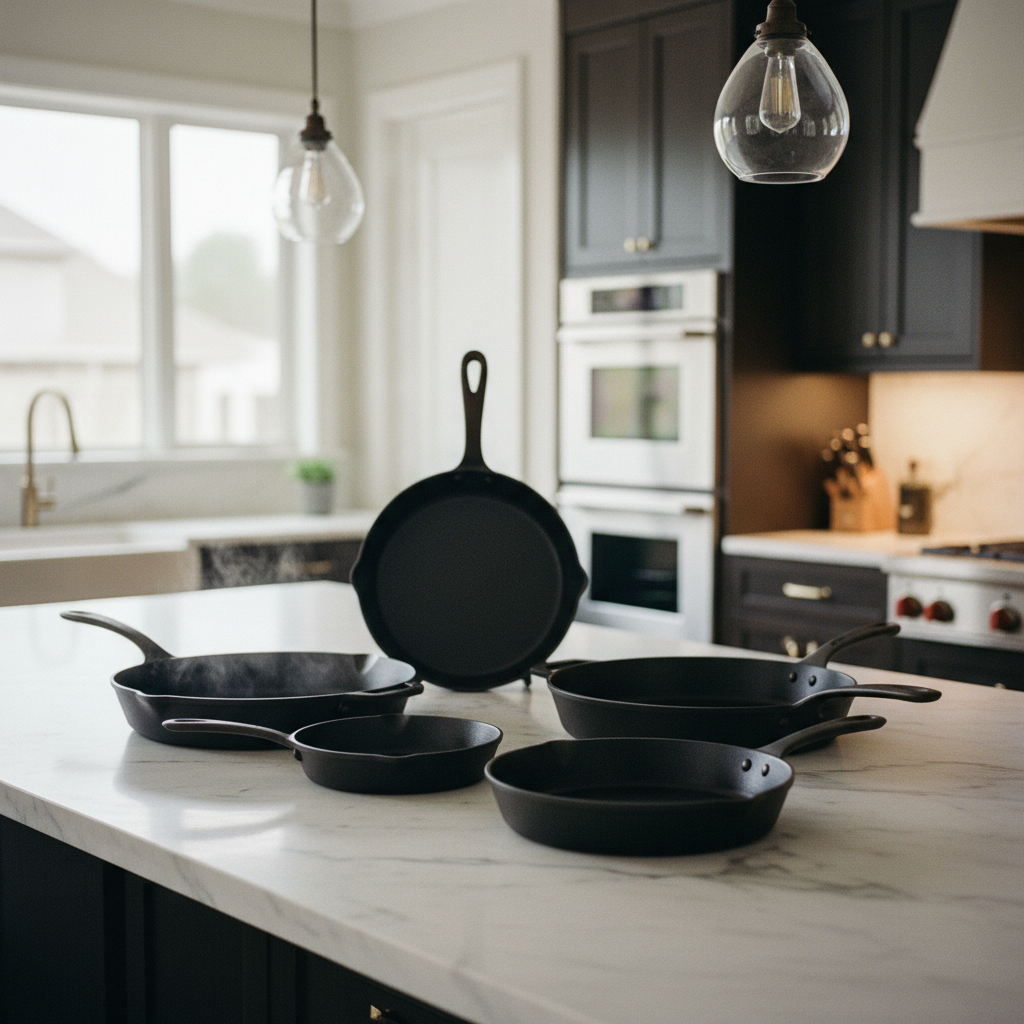
Nitriding infuses nitrogen into metal surfaces to create an incredibly hard, protective layer that resists wear, rust, and scratching while maintaining flexibility underneath. This process delivers exceptional durability and natural non-stick properties without synthetic coatings, making nitrided cookware a safer, longer-lasting investment for your kitchen.
Understanding the Nitriding Process: Basics and Benefits
Nitriding creates a hard protective surface layer while keeping the core flexible, giving your cookware durability and shock resistance that lasts.
What Is the Nitriding Process?
Think of nitriding as giving metal a suit of armor. This heat treatment infuses nitrogen into the metal's surface, creating an incredibly hard protective layer through the formation of metallic nitrides [1]. What makes this process special? It transforms the surface while keeping the core flexible--giving you the best of both worlds: a wear-resistant exterior that can handle daily abuse and a shock-absorbing interior [1].
The magic happens at relatively low temperatures (around 500-550 degreesC), which means less warping and better dimensional stability compared to other heat treatments [1][2]. While the process takes time--anywhere from 4 to 100 hours--the results are worth the wait [1]. You'll find nitriding used on everything from automotive parts to high-end cookware, particularly with steels containing aluminum, chromium, and molybdenum [1][2].
The process works through three main methods: gas, salt bath, and plasma nitriding. Each uses different techniques to deliver nitrogen to the metal surface, but they all achieve the same goal--creating that ultra-hard, protective layer [2]. Whether it's a gear that needs to withstand constant friction or cookware that faces daily kitchen challenges, nitriding delivers the durability and performance that demanding applications require [2][3].
How Nitrogen Diffusion Creates a Hard Surface
Here's where the science gets interesting--and practical for your kitchen. When nitrogen meets hot metal, it doesn't just sit on the surface. Instead, nitrogen atoms actually penetrate and bond with the metal, creating incredibly hard compounds that can reach hardness levels up to 76 HRC [1].
The result? A two-zone structure that's brilliantly engineered. The outer layer (what metallurgists call the "white layer") provides extreme hardness, while underneath, a diffusion zone creates a gradual transition to the softer core [1]. This isn't just technical jargon--it means your cookware gets a surface tough enough to handle metal utensils while maintaining the flexibility to resist cracking or chipping.
What's particularly clever about nitriding is its relatively low processing temperature. At around 500-550 degreesC, it's hot enough to create these beneficial changes but cool enough to prevent warping [1][5]. For a deeper dive into the chemistry behind this transformation, check out "The Science Behind Nitriding" section below, where we explore the specific reactions that make this process so effective.
Comparison with Other Cookware Finishes
Let's cut through the confusion and compare nitrided cookware to what's already in your kitchen. Traditional non-stick pans with PTFE coatings? They're convenient but come with a countdown clock--most need replacing every few years, and overheating can raise health concerns [6]. Nitrided surfaces, on the other hand, develop their non-stick properties naturally, without any synthetic coatings that can flake or emit fumes.
Think of nitrided cookware as the sweet spot between cast iron and modern conveniences. You get cast iron's safety and durability without the high-maintenance routine of constant seasoning and rust prevention [6]. Compared to stainless steel--which is bulletproof but can be sticky without proper technique--nitrided surfaces offer easier food release while maintaining that professional-grade durability [7].
Carbon steel pans come close in performance, developing similar natural non-stick properties and high-heat capabilities. The difference?
Common Myths About Nitrided Cookware
Let's clear up some common misconceptions that might be holding you back from trying nitrided cookware. First up: "It's just another coating that will peel off." Not true. Unlike traditional non-stick pans with synthetic coatings, the nitrogen treatment becomes part of the metal itself--it can't flake into your food or release chemicals when heated [9].
"But doesn't it need constant seasoning like cast iron?" Another myth. While a light seasoning can boost performance, nitrided surfaces naturally resist corrosion and need far less babying than traditional cast iron [9]. You won't find yourself religiously oiling your pan after every use or panicking about a little moisture.
Here's a big one: "The treatment will wear off eventually." The beauty of nitriding is that nitrogen atoms penetrate deep into the metal structure, creating a permanent transformation. This isn't a surface treatment that disappears with use--it's a fundamental change to the metal that can handle metal utensils without flinching [9].
Some skeptics dismiss nitriding as marketing fluff, but the metallurgical science is rock-solid. This process genuinely transforms how the metal performs, creating a cooking experience that's distinctly different from both traditional cast iron and synthetic non-stick options [9]. And no, there's no connection to the PFOA concerns that plagued older non-stick cookware. Nitriding uses only nitrogen and heat--no questionable chemicals involved [10].
The Science Behind Nitriding: How IT Works in Practice
Atomic nitrogen diffuses into steel at 500-550 degreesC, creating a layered structure with hardness of 800-1200 HV while keeping parts dimensionally precise.
Core Chemistry and Steel Phases
The chemistry of nitriding hinges on a simple diffusion principle where nitrogen penetrates the steel surface. When ammonia (NH₃) contacts heated steel, it catalytically decomposes into atomic nitrogen and hydrogen (NH₃ → N + 3H) [4]. For a fraction of a second, nitrogen exists in its atomic form--a crucial state that enables diffusion into the steel lattice [4]. This atomic nitrogen reacts with nitride-forming elements including iron, chromium, aluminum, molybdenum, vanadium, tungsten, and titanium [4].
The resulting metallurgy creates a distinct layered structure. The surface develops a compound layer (white layer) consisting of iron nitrides Fe₄N (γ' phase) and Fe₂-₃N (ε phase), while beneath forms a diffusion zone with nitrogen-saturated ferrite and fine nitride precipitates [11]. This structure varies based on process parameters--short-term nitriding creates primarily a diffusion zone with dispersed nitrides, while long-term treatment produces a continuous compound layer above the diffusion zone [11]. The iron-nitrogen system features four distinct phases that determine hardness properties [11].
Though any steel will nitride due to iron's presence, those containing specific alloying elements achieve superior results--aluminum increases hardness, chromium enhances layer thickness, and molybdenum prevents temper embrittlement during extended heating [12]. The expanded iron lattice combined with finely dispersed nitride precipitates effectively immobilizes dislocations, creating the characteristic hardness (800-1200 HV) that makes nitrided surfaces so valuable [11][12].
Typical Temperature and Time for Kitchen‑Grade Nitriding
Kitchen-grade nitriding occurs at temperatures between 500-550 degreesC (930-1022 degreesF), significantly lower than other heat treatments and below steel's austenitisation point [1]. This temperature range creates optimal nitrogen diffusion while minimizing part distortion--crucial for maintaining the precise dimensions of cookware. For specialized applications, temperatures may reach up to 620 degreesC (1150 degreesF) [1]. Processing time varies significantly based on desired properties, typically ranging from 4 to 100 hours [1].
Longer exposure creates deeper case hardening, with thickness generally reaching 200-300 μm, though specialized applications may extend up to 2 mm [1]. Cookware applications rarely require the longest processing times, as excessive case depth isn't necessary for kitchen use. The time-temperature relationship directly influences the formation of the compound (white) layer and diffusion zone that give nitrided cookware its characteristic properties. This carefully controlled process ensures cookware meets food safety standards--regulatory bodies including the U.S. Department of Health & Human Services have confirmed properly nitrided surfaces pose no food additive risk [13].
European testing by Kantonales Labor Zurich and Institut Nehring GmbH validates that properly treated surfaces release no harmful substances, making them safe for contact with non-acidic foodstuffs [13]. For kitchen applications, processors must balance surface hardness with practical considerations: shorter processing times (4-24 hours) produce primarily a diffusion zone with dispersed nitrides, while longer treatments create a continuous compound layer that enhances non-stick properties and corrosion resistance [13].
Gas vs Plasma Nitriding Methods
Gas and plasma nitriding create similar hardened surfaces but serve different applications. Gas nitriding uses ammonia at 500-600 degreesC, excelling with low/medium carbon steel and cast iron while handling large batches efficiently [14][16]. It's more cost-effective for high-volume production but less precise for partial treatments [16].
Plasma nitriding generates N+ ions through electrical discharge, enabling selective treatment through masking and producing no waste [16]. This method works better for complex geometries and powder metallurgy parts but requires spacing between components to prevent damaging arcs [14][16]. The choice depends on geometry, batch size, material, and environmental considerations rather than metallurgical results, which are comparable between methods [15].
For cookware applications, gas nitriding typically offers the most practical balance of cost and performance for consistent, large-scale production, while plasma nitriding might be preferred for specialty items with complex designs requiring selective hardening.
Quality Assurance: Hardness Testing and Layer Depth
Quality assurance in nitriding relies on two critical measurements: case depth and hardness profiles. Metallographic examination on cross-sections reveals the compound zone (white layer) and diffusion zone structure, enabling precise measurement of layer thickness [17]. The hardness layer typically reaches 200-300 μm but can extend to 2 mm in specialized applications, controlled through exposure duration, temperature, and gas flow parameters [1].
Microhardness testing, performed with 10 μm spacing intervals using diamond indenters, creates detailed hardness profiles that verify nitrogen penetration depth and confirm effective case hardness [17][18]. These profiles determine the effective case depth--often measured at 513 HV (equivalent to 50 HRC)--which may represent only a portion of the total case depth depending on steel composition and heat treatment history [17]. The relationship between effective and total case depth varies significantly with steel type and tempering temperature, making consistent testing protocols essential [17].
Metallographic data enables the creation of predictive models and kinetic graphs that help engineers write precise process cycles for specific steels and case depth requirements [17]. For low-alloy steels where diffusion zones aren't easily visible under microscopes, hardness testing becomes particularly crucial for verifying treatment effectiveness [17]. These quality measurements directly correlate with final component performance, as proper nitrided layer formation ensures the wear resistance, fatigue strength, and corrosion protection that make nitriding valuable [1][17].
Real‑World Advantages of Nitrided Cookware for Everyday Chefs
Nitrided cookware resists scratches from metal utensils and maintains a flat, even cooking surface for thousands of uses without the synthetic coatings found in traditional nonstick pans.
Long‑Lasting Durability and Wear Resistance
Nitrided cookware transforms kitchen durability through a surface structure that withstands challenges regular pans surrender to quickly. The nitriding process creates an extremely hard composite layer with hardness comparable to quenched steel, preventing the surface damage that typically shortens cookware lifespan [9]. This hardened surface withstands metal utensils without scratching--a significant advantage over coated nonstick options that degrade with each scrape [9].
The dense, smooth microstructure resists daily wear from cooking implements and cleaning tools, maintaining its integrity through thousands of cooking sessions where traditional pans would show significant degradation [9]. Testing confirms nitrided pans handle regular scrubbing without showing wear patterns that plague conventional cookware [19]. Unlike traditional cast iron or carbon steel that develops weak spots over time, the nitrogen-infused layer maintains consistent performance across the entire cooking surface [6].
While the initial investment exceeds standard cookware options, this resilience translates directly into years of additional service life [6]. For home chefs who frequently replace worn pans, this extended usability represents both practical value and environmental benefit through reduced consumption [19]. The durability advantage extends beyond the cooking surface--nitrided pans resist warping under high heat, maintaining flat cooking surfaces where other pans develop permanent distortions that compromise heat distribution [19].
Natural Non‑Stick Performance Without Chemicals
Nitrided cookware achieves non-stick properties through metallurgical transformation rather than synthetic coatings. During nitriding, nitrogen atoms diffuse into the metal surface, creating an extremely durable layer that naturally resists food adhesion without PFAS, PTFE, or PFOA--chemicals commonly found in traditional non-stick pans [20]. This fundamentally different approach eliminates the health concerns associated with conventional non-stick surfaces, which can release toxic fumes when heated above 500 degreesF [21].
The nitrogen-infused surface isn't a separate coating that can peel or flake into food--it's part of the metal itself [20]. Through normal cooking, nitrided pans develop additional non-stick properties through polymerization: when fats heat in the pan, they chemically bond with the metal surface, creating a durable, natural seasoning that enhances performance [20]. Real-world testing confirms these benefits--nitrided pans handle eggs (the ultimate non-stick test) effectively even with minimal oil [19].
The surface performs better at moderate temperatures and improves with use, unlike conventional non-stick pans that gradually lose effectiveness [20][19]. This combination of inherent non-stick properties and self-improving performance creates a cooking surface that maintains consistent release without the environmental persistence of PFAS-based products that never fully break down in landfills or water systems [21].
Corrosion Resistance in Humid Kitchens
Nitrided cookware excels in one of cooking's harshest environments: the moisture-rich kitchen. Unlike traditional cast iron that rusts quickly when exposed to humidity, nitrided surfaces remain unaffected even during extended exposure to damp conditions [13]. This resistance comes from the nitrogen-infused layer that creates a dense protective barrier against oxidation.
Kitchen tests confirm nitrided pans maintain their integrity through repeated exposure to steam, splashing, and condensation that would quickly deteriorate standard cookware [9]. The process forms a composite surface layer that essentially seals the metal against moisture penetration, eliminating the constant vigilance required with conventional cast iron and carbon steel pans [9]. Regulatory testing validates this performance--both U.S. Department of Health & Human Services and European regulatory bodies have confirmed properly nitrided surfaces resist corrosion while remaining food-safe [13].
This moisture resistance extends beyond cooking to storage--nitrided pans can be stacked in cabinets without developing rust spots where surfaces touch, a common failure point for traditional pans [9]. The enhanced corrosion resistance makes nitrided cookware particularly valuable in coastal areas or during humid summer months when conventional pans require extra maintenance [19]. One important limitation: while nitrided surfaces handle most kitchen environments exceptionally well, they may not be ideal for frequently cooking highly acidic foods, as extended acid exposure can eventually affect the surface [13].
Cost‑Per‑Use Savings Over Time
Nitrided cookware transforms the cost equation of kitchen tools through exceptional longevity. While conventional non-stick pans require replacement every few years as coatings degrade, nitrided pans maintain consistent performance for decades, effectively distributing the initial investment across thousands of meals [22].
This longevity creates substantial savings--a household replacing $60 non-stick pans every two years spends $600 over 20 years, while a single $150 nitrided pan covers the same period, saving $450. The economic advantage extends beyond purchase price to associated costs--nitrided pans eliminate the expense of special utensils required for delicate non-stick surfaces and reduce energy consumption through superior heat distribution [23]. Many manufacturers recognize this durability by offering lifetime warranties against defects, transforming what might initially appear as a premium purchase into a genuinely economical decision [22].
The environmental benefits complement financial savings--fewer discarded pans means less manufacturing waste and reduced landfill burden from cookware containing synthetic materials that never fully break down [23]. The intergenerational value proposition mirrors cookware from previous eras, when pans were routinely passed down through families rather than treated as disposable items [24].
Choosing Authentic Nitrided Products: What to Look For
Authentic nitrided cookware resists scratches from metal utensils, performs non-stick immediately without seasoning, and weighs less than traditional cast iron while maintaining superior durability.
Identifying Genuine Nitrided Finishes
Genuine nitrided cookware has distinctive characteristics that separate it from untreated or coated alternatives. Authentic nitrided surfaces display a smooth, dense microstructure that appears slightly darker than untreated cast iron or carbon steel [9]. Unlike conventional non-stick pans with obvious synthetic coatings, the nitrogen treatment creates a hardened layer that's part of the metal itself, not a separate coating that could potentially peel or chip [9]. One reliable indicator is weight--properly nitrided cast iron pans are typically lighter than traditional cast iron while maintaining excellent heat retention [25].
This weight reduction comes from the manufacturing process that allows for thinner construction while preserving durability. When testing a pan's surface, genuine nitrided cookware demonstrates remarkable scratch resistance--even when tested with metal utensils [9]. This resistance comes from the extremely hard composite layer formed during the nitriding process, which achieves hardness comparable to quenched steel [25]. Another key identifier is natural non-stick performance without prior seasoning.
While traditional cast iron requires extensive seasoning to develop non-stick properties, properly nitrided pans perform well immediately [25]. Authentic nitrided cookware also demonstrates superior rust resistance compared to untreated alternatives--a properly nitrided pan will resist corrosion even when exposed to humidity for extended periods [9]. When examining potential purchases, verify that both sides of the cookware have undergone the nitriding process, as quality manufacturers treat both cooking and exterior surfaces to maximize durability [9].
Key Certifications and Quality Markers
Quality nitrided cookware should carry specific certifications that verify its safety and performance. The Cookware & Bakeware Alliance (CBA) Engineering Standards provide comprehensive quality benchmarks that have evolved over 100 years to incorporate changes in materials and technology [26]. Manufacturers adhering to these standards submit their products to rigorous testing protocols specific to their material category.
FDA compliance marks another critical quality indicator, as nitrided cookware must meet food contact material regulations outlined in 21 CFR, which cover substance restrictions and good manufacturing practices [27]. Laboratory testing for lead and cadmium extraction using methods like ASTM C895-87 confirms the surface won't leach harmful substances into food [27]. Third-party certification marks from organizations like Intertek provide additional verification that products meet safety and performance requirements beyond basic regulatory compliance [28].
These independent certifications involve comprehensive testing and factory inspections that validate manufacturer claims about durability and safety [28]. For international markets, look for the IECEE CB Scheme certification, which simplifies obtaining multiple national safety certifications and indicates the product meets global standards [28]. State-specific compliance is increasingly important as places like Vermont implement regulations banning PFAS-containing cookware by 2024, making certification to these standards another quality marker [27].
How to Verify Manufacturer Claims
Verifying manufacturer claims about nitrided cookware requires both technical knowledge and practical testing. Request documentation of specific laboratory tests that confirm true nitriding--look for hardness testing results using microhardness measurements with diamond indenters at 10 μm spacing intervals, which creates detailed hardness profiles that verify nitrogen penetration depth [31]. Legitimate nitrided products should provide metallographic examination data showing compound zone (white layer) structure and measured layer thickness [31].
For abrasion resistance claims, manufacturers should demonstrate results from standardized tests like the BS 7069:1988 abrasion test, which uses 3M Scotch-Brite pads under controlled conditions to assess durability [31]. Verify non-stick performance claims through documentation of specific food-based tests like the egg test at high temperatures (300-350 degreesC), which legitimate manufacturers use to validate performance [31]. Ask for evidence of corrosion resistance testing, particularly tests using acidic food simulants at elevated temperatures--authentic nitrided cookware should pass tests like the LGA combination test AA-081 that uses 3% acetic acid at >95 degreesC [31].
Check for independent regulatory certification from FDA (21 CFR Food and Drugs) in the US or European Commission regulation EC No. 1935/2004 for food contact materials, which provide third-party validation of safety claims [30][31]. At home, conduct your own verification by examining surface characteristics--genuine nitrided surfaces display a smooth, dense microstructure that's darker than untreated cast iron, with remarkable scratch resistance even when tested with metal utensils [31]. Be skeptical of manufacturers who can't provide specific testing documentation or who make vague claims about "special proprietary processes" without supporting evidence [29].
Avoiding Cheap Imitations That Waste Resources
The market has become flooded with poor-quality imitations as nitrided cookware gains popularity. Authentic nitrided surfaces have a distinctive dull grey-black color and maintain their integrity for years, while counterfeits often feature a nitriding layer that peels or chips within a year of regular use [32]. Weight provides an immediate clue--genuine nitrided cookware has substantial heft due to proper material thickness, while imitations typically use thinner steel (often just 1.5mm compared to the 3mm in quality pans) that compromises heat distribution and durability [32].
Fake nitrided woks frequently combine cheap materials with deceptive manufacturing techniques, like stamped "hammer marks" that never overlap or intersect--a physical impossibility in authentic hand-forged products [33]. Properly nitrided cookware maintains a silver-black appearance under bright light, while counterfeits typically display a blue-black tint [33]. When examining potential purchases, test the durability by checking for loose handles and uneven finishes, as quality nitrided products feature secure construction and consistent surface treatment [34].
Investing in authentic nitrided cookware prevents the resource waste associated with repeatedly replacing inferior products--many users report that cheap imitations require the same maintenance as regular carbon steel while delivering none of the promised durability benefits [32].
Care, Maintenance, and Simple Repairs for Nitrided Cookware
Nitrided cookware requires only warm water and a soft sponge to clean, and you can safely use metal utensils without worrying about damaging the hardened surface.
Daily Cleaning and Seasoning Best Practices
Caring for nitrided cookware is refreshingly simple. After cooking, let your pan cool slightly, then clean with warm water and a soft sponge--no need to panic about immediate drying like with traditional cast iron (as we discussed in the corrosion resistance section). While the nitrogen-infused surface provides excellent rust protection [9], drying thoroughly helps maintain peak performance.
Want to boost your pan's non-stick properties? Here's a quick seasoning routine: apply a thin layer of high-smoke-point oil, heat until it just starts to smoke, then remove from heat and wipe away excess [9]. This process polymerizes the oil, creating an even slicker cooking surface. Skip harsh detergents that can strip this beneficial seasoning layer--gentle dish soap works perfectly fine.
For stubborn food residue, patience beats elbow grease every time. Let warm water do the work by soaking for a few minutes rather than aggressive scrubbing. This gentle approach preserves both the hardened nitrided surface and the natural seasoning that builds up with each use [9].
Protecting the Surface from Abrasive Tools
Here's the good news: nitrided cookware can handle your metal spatulas without drama. That nitrogen-hardened surface is tough enough to withstand regular metal utensils--something that would destroy traditional non-stick pans [9]. Go ahead and use that fish spatula without fear.
Still, a few smart storage habits keep your pans looking pristine. Hang them when possible, or use pan protectors between stacked pieces to prevent contact scratches. While wood and silicone tools are gentler on the seasoned surface layer, don't stress if you reach for metal--you won't damage the nitrided layer underneath [9].
Here's what makes nitrided surfaces different: scratches on the seasoning layer (not the nitrided surface itself) won't compromise cooking performance or safety like they would on coated pans [35]. Notice some wear on your seasoning? Simply clean and re-season--no need to replace the entire pan like you would with damaged non-stick cookware [9].
Managing High‑Heat Usage Safely
Temperature management with nitrided cookware is straightforward. Most manufacturers, including those producing carbon steel pans, recommend staying under 450 degreesF [36]. Push past this limit and you won't release toxins--nitrogen simply migrates deeper into the metal or disperses harmlessly into the air (which is already 70% nitrogen) [36].
That said, extreme heat has trade-offs. Extended exposure above 930 degreesF can reduce corrosion resistance and potentially make the metal more brittle [36]. For everyday cooking, this isn't a concern--you'd need seriously excessive heat for prolonged periods to cause issues.
Unlike pans with synthetic coatings, overheating won't cause flaking or toxic fumes [9]. The nitrogen is part of the metal structure itself, not a coating that can break down [37]. For best results, stick to medium or medium-high heat for most cooking. Save the blazing heat for quick searing tasks where it's actually needed.
DIY Touch‑Up and Repair Options
DIY touch-up and repair options
Good news: nitrided cookware is surprisingly fixable. Unlike coated pans that need replacing when damaged, you can often restore nitrided surfaces yourself.
Start simple for minor issues. Mix warm water with dish soap and gently scrub with a non-abrasive sponge [40]. Stubborn residue? Make a baking soda paste, let it sit for 30 minutes, then gently scrub clean [40].
When performance drops, try this reconditioning routine: heat the pan on medium for 2-3 minutes, apply a thin layer of high-smoke-point oil, continue heating for 5-10 minutes, then wipe away excess after cooling [40]. Some users report success using steel wool on overheated spots to restore non-stick properties, though results vary [39].
Remember--the nitrided layer is part of the metal, not a coating that peels off [39]. This fundamental difference means you can often restore performance where conventional non-stick pans would be trash. However, know your limits: severely warped pans or those with deep gouges penetrating the hardened layer are better replaced than repaired [40].
Sustainable Nitriding: Eco‑Friendly Production and Future Trends
Low-temperature nitriding reduces energy consumption by 30-40% compared to traditional heat treatment while producing minimal environmental waste and enabling carbon footprint reductions up to 60% when paired with renewable energy sources.
Energy‑Efficient Low‑Temperature Nitriding
Low-temperature nitriding processes operate between 560-590 degreesC (1040-1090 degreesF), significantly below traditional heat treatment temperatures, reducing energy consumption while minimizing part distortion. This temperature range remains below steel's critical transformation point, preventing unwanted phase changes that require additional energy to reverse [41]. Unlike conventional carburizing at 900 degreesC+, nitriding and nitrocarburizing create case-hardened surfaces without crossing the austenitization threshold, reducing overall thermal energy requirements by 30-40% [41][42].
Recent innovations have further improved efficiency through precise atmosphere control and temperature management, with manufacturers developing specialized equipment that optimizes gas flow and heating element placement specifically for these processes [42]. Modern programmable controllers maintain exact temperatures throughout the cycle, preventing energy waste from temperature fluctuations while ensuring consistent metallurgical results [42]. These processes produce minimal environmental waste compared to traditional methods--using readily available ammonia, carbon dioxide, and natural gas rather than hazardous compounds that require extensive treatment [41].
General Motors demonstrated significant energy savings when implementing ferritic nitrocarburizing for brake rotors, where the process temperature of approximately 560 degreesC compared favorably against traditional treatments requiring 900 degreesC+ [42]. Companies combining these energy-efficient processes with renewable energy sources have reported total carbon footprint reductions of up to 60% compared to conventional heat treating operations [42]. The automotive industry has embraced these energy advantages, particularly for electric vehicle components where reduced processing temperatures complement the sector's overall sustainability goals [42].
Emerging Home‑Cooking Applications
Nitrided cookware is gaining traction as home cooks increasingly prioritize both performance and sustainability. The market shift away from traditional non-stick surfaces containing PFAS, PTFE, and other "forever chemicals" has created demand for alternatives that combine durability with safe cooking surfaces [43]. This aligns perfectly with nitrided cookware's chemical-free approach to non-stick performance.
Unlike conventional PTFE-coated pans that typically last 3-5 years before requiring replacement, nitrided surfaces maintain their properties for decades, significantly reducing the environmental footprint of frequent cookware replacement [45]. The exceptional durability addresses a fundamental principle of kitchen sustainability - investing in cookware that outlasts multiple generations of conventional alternatives [45]. The fuel efficiency advantage of nitrided pans also appeals to eco-conscious cooks - their excellent heat retention means burners can be turned off earlier, allowing residual heat to complete cooking [45].
This property places nitrided cookware alongside cast iron in sustainability rankings, but with easier maintenance requirements [45]. As consumer awareness grows about the environmental impacts of cookware materials, nitrided options fill a crucial gap for those seeking the performance of premium cookware without the environmental concerns of conventional non-stick surfaces or the high maintenance needs of traditional cast iron [44]. Home chefs increasingly recognize that sustainable kitchen equipment represents an investment rather than merely an expense - the higher initial cost of nitrided cookware is offset by its exceptional longevity and consistent performance through years of daily use [44].
Industry Moves Toward Affordable, Standardized Nitrided Cookware
The cookware market is rapidly evolving as manufacturers respond to growing consumer demand for sustainable, chemical-free kitchen tools. Industry projections show significant growth, with the market expected to expand from $29.41 billion in 2024 to $42.20 billion by 2030--a 6.19% CAGR that reflects shifting preferences toward eco-friendly options [46]. This expansion creates opportunities for nitrided cookware to move from specialty status to mainstream adoption through standardized production processes. Manufacturers are increasingly investing in scaling nitrided cookware production, recognizing that standardization reduces manufacturing costs while maintaining the core benefits that attract consumers.
The introduction of new U.S. import tariffs on raw materials in 2025 has accelerated this trend, with companies developing strategic sourcing partnerships and nearshoring initiatives to mitigate cost increases [46]. These adaptations are helping manufacturers maintain competitive pricing while transitioning to more sustainable production methods. Consumer education has become a focal point in marketing strategies, with brands highlighting the long-term value proposition of nitrided cookware. They emphasize that while initial purchase prices may exceed conventional non-stick options, the exceptional longevity--with pans lasting decades rather than requiring replacement every few years--represents significant savings over time [43].
This cost-per-use calculation resonates with increasingly sustainability-minded consumers seeking both performance and environmental responsibility. The restaurant industry has emerged as an important driver of nitrided cookware standardization, with commercial kitchens recognizing the operational benefits of longer-lasting, chemical-free cooking surfaces [47]. As commercial adoption increases, manufacturing efficiencies follow, gradually reducing costs for consumer markets as well. This virtuous cycle of increased demand leading to production scaling and subsequent price reductions suggests nitrided cookware is following the classic technology adoption curve, moving from early adopters to early majority customers as affordability improves.
- Nitriding infuses nitrogen into metal at 500-550 degreesC, creating a hard protective layer while keeping the core flexible, unlike other heat treatments that cause warping.
- Nitrided surfaces develop non-stick properties naturally through metallurgical transformation without synthetic coatings, PFAS, or PTFE chemicals found in traditional non-stick cookware.
- A single nitrided pan lasting 20+ years costs less than repeatedly replacing conventional non-stick pans every 2-3 years, reducing both waste and household expenses.
- Nitrided cookware resists rust and corrosion even in humid conditions because the nitrogen-infused layer seals the metal against moisture penetration.
- Authentic nitrided cookware displays a smooth, dull grey-black surface with scratch resistance to metal utensils, distinguishing it from counterfeits that peel within a year.
- Nitriding processes consume 30-40% less energy than traditional heat treatments by operating below steel's critical transformation point, reducing manufacturing carbon footprint.
- Scratches on the seasoning layer of nitrided cookware don't compromise safety or performance like they would on coated pans, and the surface can be restored through simple re-seasoning.
- https://fractory.com/nitriding-explained/
- https://en.wikipedia.org/wiki/Nitriding
- https://thermo-fusion.com/nitriding/
- https://themonty.com/nitriding-process-methods-and-metallurgy/
- https://thermalprocessing.com/the-influence-of-induction-hardening-nitriding-and-boronizing-on-certain-steels/
- https://n-pioneer.com/products-kitchen-cookware-nitrided-iron-pan/
- https://www.cupindy.com/blogs/info/cooking-pans-materials-guide?srsltid=AfmBOooOMVUWXl6YqxNiJzF_Xm-rqbs5KyJfz-Hz47wBzN9aF6yHDtCt
- https://nest-wellness.com/blog/healthy-cookware-and-food-storage/
- https://www.sarchicookware.com/news/is-nitriding-cookware-safe-to-use.html
- https://virgamet.com/blog/nitriding
- https://www.sciencedirect.com/topics/materials-science/nitriding
- https://www.nitrera.com/articles/nitriding-for-food-safe-applications
- https://www.nitrex.com/en/ion-plasma-nitriding-versus-gas-nitriding/
- https://www.ahtcorp.com/articles/blog/ion-nitriding-vs-gas-nitriding-the-pros-and-cons/
- https://www.groupe-thermi-lyon.com/en/blog/procedes-nitruration/
- https://www.ahtcorp.com/articles/blog/controlling-nitriding-process-and-layers-with-metallography/
- https://www.sciencedirect.com/science/article/pii/S2238785422008596
- https://fields.medium.com/the-misen-nitrided-carbon-nonstick-pan-seems-like-a-massive-sea-change-in-cookware-0a346c50d901
- https://www.kickstarter.com/projects/misenkitchen/the-misen-carbon-nonstick-pan/faqs
- https://foodprint.org/blog/what-to-know-about-nonstick-cookware/
- https://misen.pro/products/carbon-nonstick-pan?srsltid=AfmBOopHi34yzGHMO07Hkt18gYXx3Ptwjs-uNQHSDt2lggSU5pzJVbMm
- https://www.bonappetit.com/story/best-carbon-steel-pans?srsltid=AfmBOop6v0rKYUG1wIfhwgcx4xz2YVuBiH53N3RLKIX8aqu4Lgb2V9R-
- https://medium.com/at-home-publication/forget-about-non-stick-these-pans-and-pots-will-last-you-a-lifetime-9bf7784ab3e5
- https://cnsarchicookware.medium.com/why-do-hard-nitriding-cast-iron-skillet-excel-in-every-way-502d55a449b
- https://cookwareandbakeware.org/engineering-standards/
- https://www.compliancegate.com/cookware-regulations-united-states/
- https://www.intertek.com/product-certification-marks/
- https://www.eurofinsus.com/food-testing/services/testing-services/authenticity/
- https://www.api-hk.com/the-cookware-laboratory-tests-that-you-should-know/
- https://www.ilag-group.com/en/coatings-for-consumer-goods/retail-brands/test-methods/
- https://www.reddit.com/r/carbonsteel/comments/eoiw5r/i_saw_a_pan_in_the_store_it_had_words_i_had_never/
- https://oxenforge.com/blogs/blog/beware-of-fake-hand-hammered-woks?srsltid=AfmBOop5A0Vcu07ympYYJXtqA4esvsGNcyVy0fVdD71gVpiEFaDxvm0v
- https://www.zhenneng.com/a-news-spotting-authenticity-how-to-differentiate-genuine-stainless-steel-pots-from-counterfeits
- https://support.hestancue.com/en/support/solutions/articles/19000071068-my-cue-cookware-got-scratched-while-cooking-what-do-i-do-
- https://cooking.stackexchange.com/questions/123438/what-happens-to-nitride-treated-carbon-steel-skillet-if-overheated
- https://misen.pro/products/carbon-nonstick-pan?srsltid=AfmBOooZTnw4BeoB9srRZs_JwsCovgqiWr1mb76Ps3kXZz-vNX98RVG4
- https://thedollarstretcher.com/frugal-living/restoring-non-stick-cookware/
- https://www.reddit.com/r/cookware/comments/1ndisao/anyone_else_increasingly_suspect_misen_is_doing/
- https://www.fldcoating.com/How-to-Restore-Non-Stick-Coating-id45861685.html
- https://www.sciencedirect.com/science/article/abs/pii/S2214785320393007
- https://www.heattreattoday.com/category/nitrocarburizing-technical-content/
- https://gourmetkitchenworks.com/blogs/recipes/eco-friendly-cookware-a-comprehensive-guide-to-sustainable-cooking-solutions
- https://www.foodnetwork.com/how-to/packages/shopping/sustainable-and-eco-friendly-cookware-brands
- https://stanfordmag.org/contents/sustainable-cookware
- https://www.globenewswire.com/news-release/2025/08/13/3132558/28124/en/Cookware-Market-Trends-and-Company-Strategies-to-2030-Rapid-Adoption-of-Eco-Friendly-Ceramic-Cookware-Alternatives-by-Health-Conscious-Consumers.html
- https://www.hodegroup.com/eco-friendly-commercial-cookware-sustainable-options-for-restaurants/
- Summary
- Understanding the Nitriding Process: Basics and Benefits
- The Science Behind Nitriding: How IT Works in Practice
- Real‑World Advantages of Nitrided Cookware for Everyday Chefs
- Choosing Authentic Nitrided Products: What to Look For
- Care, Maintenance, and Simple Repairs for Nitrided Cookware
- Sustainable Nitriding: Eco‑Friendly Production and Future Trends
- Key Takeaways
- References