

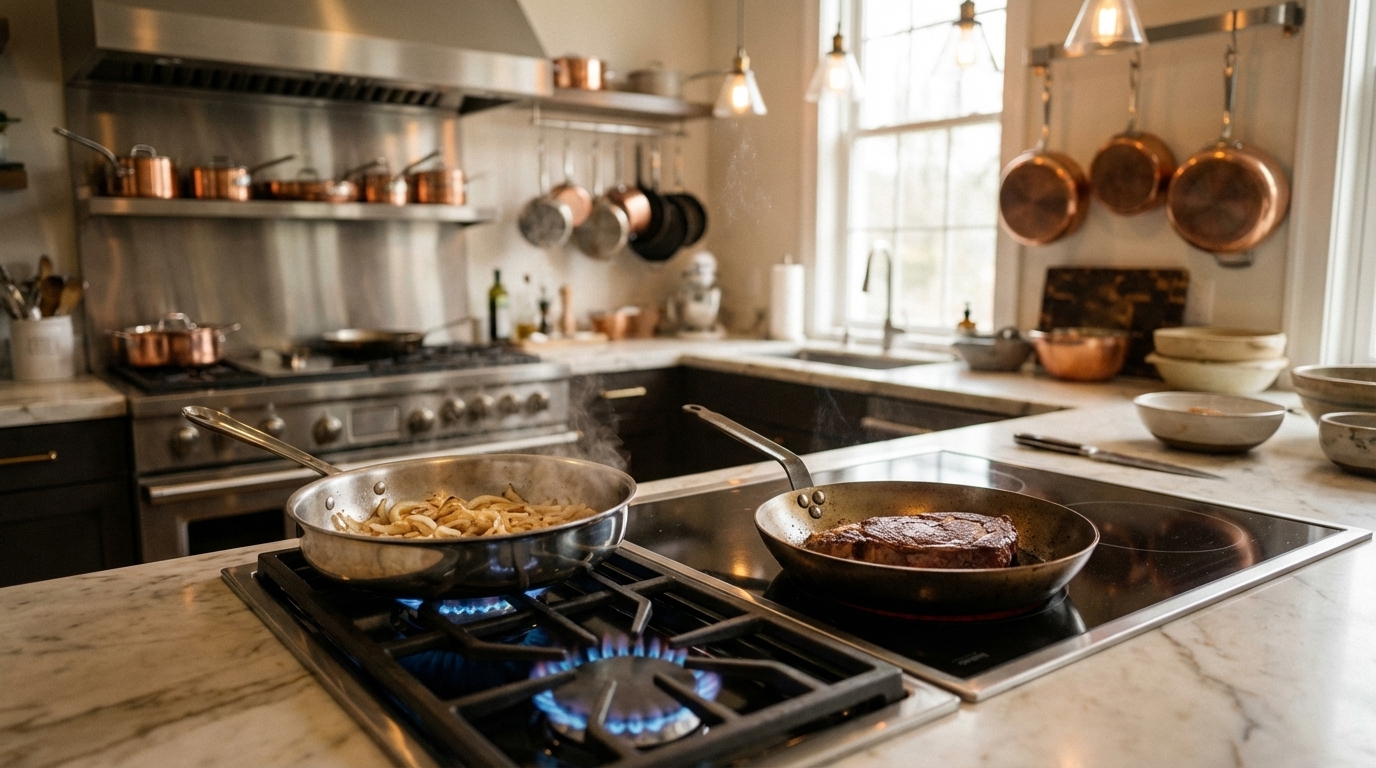
Gas burners deliver instant, visible heat that lets skilled cooks sear, stir-fry and micro-adjust temperatures on the fly, while glass-top electrics trade that immediacy for steady, set-and-forget consistency that excels at simmering sauces or holding batches at temperature; the article shows how to exploit each strength, from lifting the pan on electric to offset lingering coil heat, to using gas's flame feedback for perfect wok browning. Pan choice multiplies these effects: multi-ply stainless evens out gas's hot spot and stays flat on glass, carbon steel loves gas's rapid tweaks but works on electric if the base stays true, and non-stick suits either burner yet overheats above 500 degreesF, so size the flame or stay low on electric. Readers learn practical cues--butter's quiet melt equals low, shimmering oil signals medium, aggressive smoke means high--and pick up pro moves like preheating one notch lower when switching to gas, boiling vinegar-water to rescue scorched stainless, and slipping a towel between stacked pans to double coating life. The payoff is twofold: better cooking results by matching burner quirks to the task, and dramatically longer pan life through smart cleaning, seasoning and storage, saving money and keeping cookware out of landfills.
Understanding Burner Types: How Gas and Glass Differ
Gas delivers instant, adjustable heat for hands-on cooks, while glass-top electric stores steady warmth for low-maintenance, even simmering.
Heat distribution basics for pan gas cooking
Gas burners direct heat upward through an open flame, concentrating the most intense heat at the center of your pan while the edges stay comparatively cooler. [1] This uneven distribution isn't necessarily a flaw -- it's a characteristic you can cook around once you understand it, pushing food toward the edges to reduce heat or keeping it central for a hard sear.
The flame also loses some energy to the surrounding air rather than transferring it entirely to the pan, making gas inherently less thermally efficient than it appears. [2] Glass-top electric surfaces, by contrast, use heating elements sized to match common pan diameters, spreading heat more uniformly across the contact zone. [1] The trade-off is responsiveness: gas output changes the moment you turn the knob, while electric elements regulate temperature by cycling their heat up and down, creating minor fluctuations that gas simply doesn't produce. [1] For pan cooking specifically, this means gas gives you faster, more direct feedback -- what you see in the flame reflects what's happening at the pan's base almost instantly.
Flame control vs. electric surface stability
Gas gives you immediate visual feedback -- you can see the flame and know exactly what's happening with your heat. That visual cue matters when you're actively cooking. [4] Turn down the flame, and your pan cools within seconds.
Electric burners work differently: they store heat in their coils and keep releasing it even after you've turned down the dial. [5] But here's what many cooks miss -- that stored heat can work for you. Electric surfaces excel at holding steady temperatures once they're dialed in, which makes them ideal for tasks that need consistent heat without constant adjustment. [5] Think slow-simmering sauces or keeping a pan warm between batches.
The bottom line: gas works best when you're actively managing heat (that's why our stainless steel and carbon steel pans respond so well to flame adjustments), while electric shines when you need to set it and forget it.

Impact on Everyday Cooking: Real‑World Scenarios
Master each burner's quirks--gas for instant heat changes, electric for steady simmers--and you'll turn sautéed onions and steamed broccoli into effortless weeknight wins.
Steaming broccoli and sautéing onions on gas vs. glass
These two tasks expose the difference between the burner types more clearly than most. Sautéing onions demands a temperature drop mid-cook -- high heat to start the caramelization, then a quick pullback before they scorch. On gas, that transition is immediate: reduce the flame and the pan responds within seconds. [4] On a glass-top electric surface, the coil continues releasing stored heat after you dial back the setting, so onions keep cooking at the old temperature for longer than expected. [6] The workaround is to lift the pan briefly or shift it off the element -- neither ideal, but effective.
Steaming broccoli flips the advantage. Once you've brought the water to a boil, you want a steady, low simmer that holds without babysitting. Electric surfaces, once they reach target temperature, maintain a consistent plateau without much fluctuation, [6] which means you can step away without the steam dropping off or boiling over.
Gas requires more active attention here -- the flame needs small adjustments to hold that narrow band between too low and too aggressive, and even a brief spike can push your lid off. [4] Neither burner makes these tasks difficult, but knowing which direction each burner's quirks run lets you cook with them rather than against them.
Searing, browning, and delicate sauces with pan gas
When it comes to high-heat tasks like searing, the open flame's visual feedback pays off most -- you can see the intensity before the pan confirms it, which matters when the window between a perfect crust and an overcooked center is narrow.
Blind taste tests comparing gas and induction-seared steaks found no detectable flavor difference between the two methods, suggesting that technique -- pan preheating, timing, not crowding the surface -- drives the outcome more than the burner does. [7] That said, gas has a specific edge for wok-style browning and anything requiring heat up the sides of the pan, not just the base; glass cooktops transfer heat only through flat contact, leaving the curved walls of a wok or a rounded sauté pan comparatively cool. [8] Delicate sauces flip the calculation.
A beurre blanc or a hollandaise needs heat low enough that fat stays emulsified rather than breaking -- and while gas lets you drop that flame immediately, holding a precise, steady low temperature on gas requires active attention because the flame can fluctuate slightly, whereas a glass electric surface cycles to maintain a stable plateau once set. [7] The practical split: use gas's flame visibility for searing and wok work where dynamic heat management matters; treat its low-end instability as a variable to watch when your sauce has zero tolerance for a spike.
Choosing the Right Pan for Your Burner
Match your pan to your burner--multi-ply stainless for all-round reliability, carbon steel for gas-flash responsiveness, and non-stick only for gentle heat--and you'll buy once, cook better, and waste less.
Material match: stainless, carbon steel, and non‑stick on gas and glass
The pan material you choose shapes how each burner's quirks play out in practice. Multi-ply stainless steel -- 3-ply or 5-ply with an aluminum core -- is the most versatile across both burner types.
The aluminum layer compensates for stainless steel's relatively poor conductivity, distributing heat evenly whether the source is a gas flame concentrating at the pan's center or a glass element pushing heat upward from a fixed contact zone. [9] Its warp-resistant construction also keeps it flush against glass surfaces, which matters because even minor warping reduces contact and creates uneven cooking zones on smooth tops. [10] Carbon steel offers a different trade-off: it heats fast, responds almost instantly to flame adjustments, and builds a natural nonstick seasoning over time -- characteristics that align well with gas cooking's dynamic, high-heat style. [11] On glass tops it performs reliably too, provided the base stays flat; a seasoned carbon steel pan with a true flat bottom sits flush and transfers heat cleanly. [10] Non-stick pans, whether hard-anodized aluminum or coated steel, work on both burners but carry a firm upper limit: most coatings degrade above 500 degreesF, which rules out high-heat searing regardless of what's underneath them. [11] On glass, their flat bases and lighter weight make them well-suited for low-heat work like eggs or delicate fish. On gas, the open flame can reach up the pan's exposed sides, which means non-stick coating above the base takes direct heat that shortens its usable life -- a reason to keep gas burner size matched to pan diameter when using coated cookware. [9]
Durability, maintenance, and cost‑effective quality
Durability gaps between cookware tiers show up faster than most buyers expect.
Budget pans typically start declining within six to twelve months of regular use, while quality cookware -- maintained correctly -- can last decades. [12] The cost-per-use math heavily favors the more expensive pan over time, and the environmental case is equally clear: most failed pans aren't recyclable and end up in landfills. [12] Material choice shapes that lifespan calculus differently depending on your burner.
Carbon steel and cast iron are both cheap upfront and nearly indestructible if cared for, but they require periodic seasoning and hand-washing -- skip either and you get rust. [13] Clad stainless, by contrast, demands almost no special treatment: it's dishwasher-safe, non-reactive, and its multi-layer construction resists warping, which matters most on glass tops where even slight distortion breaks contact and creates hot spots. [14] Non-stick coatings are the short-term option in this group -- convenient, but the coating degrades over time regardless of burner type, and heat above 500 degreesF accelerates that breakdown. [13] The practical signal that any pan has reached the end of its useful life: warping, flaking, uneven heating, or a nonstick surface that now burns food it used to release cleanly. [12] Before replacing, do a full clean and re-season if applicable -- sometimes what looks like wear is just residue.
Practical Tips to Maximize Performance and Longevity
Master your gas burner by watching butter melt, oil shimmer, and ingredients sizzle--then pair that visual language with the right cleaning ritual to make every pan last for years of meals.
Heat‑up techniques and temperature monitoring for pan gas
Your gas burner's knob tells you less than you think. That "high" setting means something completely different on your power burner (often 20,000 BTUs) versus the simmer burner next to it (maybe 8,000 BTUs). [15] The real secret? Learn to read what your pan's telling you, not what the dial says. Here's your practical heat guide: preheat for one to two minutes, then watch how ingredients behave. [16] Butter melting slowly without noise means low heat. Oil shimmering with a gentle sizzle on contact?
You're at medium. When oil moves fast across the surface with wisps of smoke, you've hit medium-high. And if it smokes immediately with an aggressive sizzle, that's high heat. [15] Remember the gas advantage we discussed earlier -- instant response when you adjust the flame. [17] But that same responsiveness makes finding the sweet spot for simmering tricky. Go too low and the flame dies; nail it and you get that perfect gentle bubble. Pro tip: if you're switching from electric, start one setting lower than recipes suggest.
Gas burners often run hotter than electric at equivalent settings. [17] Want precision? An infrared thermometer takes the guesswork out, especially when learning a new stove. But honestly, after a few cooking sessions, you'll read those visual and sound cues like second nature. [16]
Cleaning, care, and avoiding landfill waste
The right cleaning routine can add years to your cookware's life -- and keep pans out of landfills. As we covered in the materials section, each type has specific care needs that directly impact longevity. Quick material guide: Stainless steel handles dishwashers fine, but hand washing with hot soapy water keeps that shine longer. [18] Cast iron and carbon steel? Never soak them or run them through the dishwasher -- water causes rust that's tough to reverse. [18] For nonstick, stick to soft sponges and mild soap. Aggressive scrubbing damages coatings faster than high heat, and scratched PTFE can release particles you don't want in your food. [19] [20] Got stubborn burnt bits on stainless?
Here's a trick: boil equal parts water and vinegar in the pan, then sprinkle baking soda after removing from heat. Watch it bubble away what scrubbing can't touch. [18] Cast iron looking rough? Often just needs a fresh seasoning round. Storage matters more than most cooks realize. Direct stacking grinds surfaces together with every movement -- especially damaging for nonstick coatings.
Simple fix: slide a pan protector or even a dish towel between each piece. This tiny step can double your cookware's lifespan. [20] Remember, most damaged cookware can't be recycled, making proper care your most eco-friendly move. Those small daily habits -- gentle cleaning, smart storage -- are what keep quality pans performing for decades instead of years. [20]
- Gas burners give instant heat changes but waste energy to the air and heat pans unevenly.
- Glass-tops hold steady, low heat once set, making them better for simmering without babysitting.
- Match pan size to burner: gas flames licking non-stick sides above 500 degreesF ruin coatings faster.
- Multi-ply stainless compensates for both gas hot-spots and glass flat-zone limits, staying warp-free.
- Carbon steel's quick response pairs best with gas; keep its base flat for glass contact.
- Budget pans fail in 6-12 months; quality cookware lasts decades and cuts landfill waste.
- Read butter/oil cues, not dial numbers: shimmer = medium, immediate smoke = high heat.
- https://www.reddit.com/r/changemyview/comments/10a2an3/cmv_modern_glasstop_electric_stoves_seem_superior/
- https://www.vanvreedes.com/blog/induction-vs-gas-vs-electric-cooktops?srsltid=AfmBOorhaCkc6Vgxfhek8Z-9FxlHcaMRF1BTmqNntNwpPAzNyx7qlAf-
- https://www.kitchenaid.com/pinch-of-help/major-appliances/gas-vs-electric-stove.html
- https://www.reddit.com/r/AskCulinary/comments/1fhwrd/what_are_the_pros_and_cons_of_gas_vs_electric/
- https://beyondappliances.in/blogs/healthy-kitchen-living/gas-vs-electric-ultimate-burner-quality-guide
- https://www.plessers.com/blog/gas_vs_electric_vs_induction_which_cooking_best?srsltid=AfmBOoqrfrYcR4kKcO9VAhcDkypf76nN8M_jQig8Wur7AoCP8PbrpvXO
- https://www.blvdhome.com/blog/Induction-vs-gas-range-test
- https://westseattleblog.com/forums-2/topic/kitchen-range-glass-or-gas/
- https://www.debuyer-usa.com/blogs/guides/say-goodbye-to-hot-spots-best-pots-and-pans-for-electric-stoves?srsltid=AfmBOoo_nFr2hxMOjng70Lvdw59LJbgGkWIzmqdEQuQL_B1oOFw7w1hb
- https://gaslandchef.com/blogs/news/how-to-choose-the-best-gas-cooktop-cookware?srsltid=AfmBOorb-ELZ6goAAzJHLxTP7Ml7-vKcteS0iwqVnpUbpIR411VvHikP
- https://www.vikingculinaryproducts.com/blogs/articles/best-cookware-gas-electric-induction-stoves?srsltid=AfmBOoruPGCBSFtl9KiR3AMwGnHS7Q4TywPeRrwlc6yo5Zs6fkqpRK_E
- https://www.debuyer-usa.com/blogs/news/the-secret-to-longevity-how-long-do-pots-and-pans-last?srsltid=AfmBOop-VqGCncokNncZ2h597kYkzudDW7YqqFvjbLddwBpzZR9iIx14
- https://www.consumerreports.org/home-garden/cookware/buying-guide/
- https://www.reddit.com/r/Cooking/comments/78z0jk/cast_iron_carbon_steel_or_stainless_steel_skillet/
- https://www.seriouseats.com/stovetop-heat-test-11822178
- https://www.recipe2kitchen.com/blog/the-science-of-heat-how-to-control-your-burners-for-better-cooking
- https://www.thorkitchen.com/blogs/post/gas-range-cooking-tips?srsltid=AfmBOooLmz62hQJNcMA4946Gk9SD_7cdVz75460yGPgWIkeyJIVF9CDP
- https://www.maytag.com/blog/kitchen/how-to-clean-pots-and-pans.html
- https://cosmoappliances.com/best-practices-for-cleaning-and-storing-cookware/
- https://www.cookut.com/en/blog/maintaining-pots-and-pans