

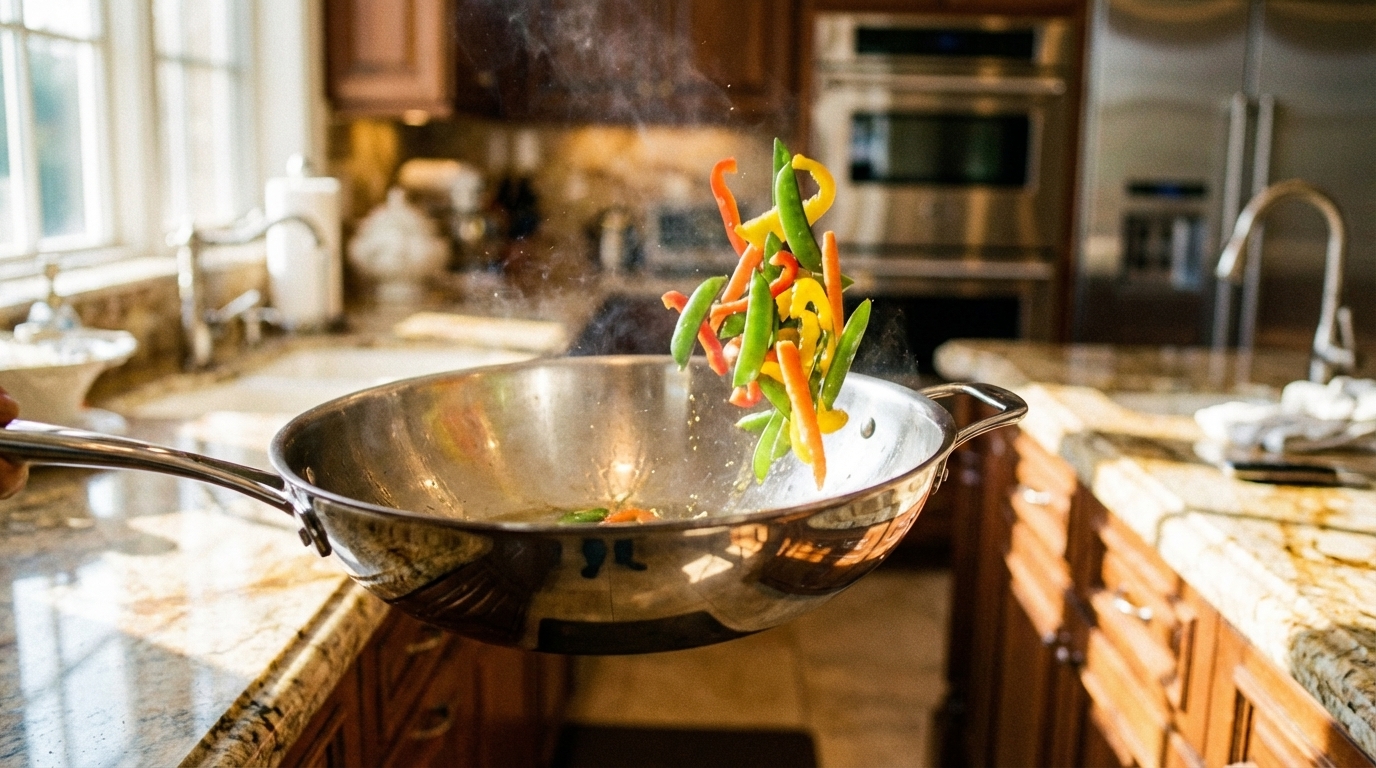
Crank your stainless steel pan to stir-fry temps without chemical coatings or PFAS worries; a quick hot-oil prep creates a natural, food-releasing surface every time. Enjoy decades of safer, high-heat cooking and easy cleanup when you shield the pan from scratches and moisture between uses.
Why Choose Stainless Steel for a Chemical-Free Stir Fry
Health and flavor advantages of stainless steel
Stainless steel's health advantage starts with what it lacks: synthetic coatings.
Most non-stick pans rely on PTFE coatings that can release toxic fumes when overheated, and long-term exposure to compounds like PFOA has been linked to cancer and thyroid disease.[1] Stainless steel contains no such coatings and won't react with the enzymes or acids in your food -- making it a dependable surface for a chemical-free stir fry in a stainless pan.[2] The bare metal also enables the Maillard reaction, the browning process that gives vegetables and proteins deeper color and more complex flavor, something coated pans simply can't replicate.[3]
How stainless steel eliminates the need for non‑stick coatings
The non-stick effect in stainless steel comes from heat management, not a coating.
When you preheat a stainless pan properly -- without oil -- the metal's microscopic pores expand and stabilize, creating a surface where food is far less likely to bond.[4] Adding oil only after the pan reaches this temperature gives you a thin, even layer that functions the same way a synthetic coating would, without any chemical involvement.[5] As a result, properly heated stainless steel requires no added fat to prevent sticking, giving you complete control over what goes into your pan.[6]

Preparing Your Kitchen and Ingredients for Success
Essential tools and pan prep with Misen stainless cookware
For stir-fry, pan choice and tool selection directly affect results.
A tri-ply stainless pan -- aluminum core between two steel layers -- distributes heat evenly across the surface, which matters when small, fast-moving ingredients need consistent contact with high heat.[7] Before first use, wash the pan with hot soapy water to remove manufacturing residue, then dry completely before heating.[7] Use wooden or silicone tools rather than metal to protect the surface, and choose a high smoke point oil like grapeseed or avocado -- both stay stable at stir-fry temperatures without breaking down or leaving residue.[8] Misen stainless pans use this tri-ply build, so they're ready for high-heat cooking without any additional conditioning.[7]
Selecting fresh, low‑chemical ingredients and sauces
Bottled stir-fry sauces often contain preservatives, excess sodium, and flavor additives that work against a clean cooking setup.
A homemade version made from low-sodium soy sauce, fresh garlic, ginger, and cornstarch takes about five minutes and lets you control every ingredient going into the pan.[9] Coconut aminos serve as a useful soy-free, lower-sodium alternative to soy sauce without meaningfully changing the flavor profile.[10] For produce, fresh vegetables like bell peppers, broccoli, snow peas, and green beans hold up to high heat and provide fiber, potassium, and vitamins A and C -- making them the right call for both flavor and nutrition.[11]
Step‑by‑Step Chemical‑Free Stir Fry in Stainless Pan
Timing, tossing, and finishing touches for perfect texture
Timing and finishing technique determine whether a stir-fry stays crisp or turns soggy.
Add vegetables in order of cooking time -- longer-cooking first, quick-cooking last -- giving each 30-60 seconds before the next addition.[12] When everything is nearly done, push ingredients to one side, pour your pre-mixed sauce into the empty space, let it bubble briefly, then toss everything together; the sauce should thicken and coat within 30-60 seconds, and if it tightens too fast, a small splash of water loosens it without diluting flavor. [13] Pour the sauce around the pan's perimeter rather than the center to avoid cooling the surface and generating steam that dulls the sear you've built. [12] Finish with garnishes like sliced scallions, sesame seeds, or chili oil -- none of which require cooking -- and serve immediately before carry-over heat softens the texture.[13]


Maintaining Your Stainless Pan for Long‑Term, Coating‑Free Cooking
Cleaning methods that preserve the pan's surface
After stir-fry, deglaze the still-hot pan with hot water, then scrub with dish soap and a scouring pad using circular motions -- most messes clear in under five minutes.[14] For scorched oil that won't budge, Bar Keepers Friend works by combining oxalic acid, a mineral abrasive, and a surfactant; the acid dissolves sticky residue at the molecular level while the abrasive scrubs it free.[15] Baking soda paste is a reliable fallback for lighter staining and can sit on the surface longer without damage, though it requires more scrubbing effort.[16] Always let the pan cool fully before submerging it in cold water -- the rapid temperature shift can warp the metal -- and follow our how to clean stainless steel pans guide for more detailed care & maintenance tips.[14]
Storage and care tips to extend lifespan and reduce waste
How you store your pan matters as much as how you clean it.
Place a silicone or felt pan protector between stacked pans to prevent metal-on-metal contact that can scratch the cooking surface -- scratches don't affect performance, but they do make cleanup harder over time.[17] If space allows, hanging your pan on a wall rack eliminates stacking pressure entirely and keeps handles from bending under weight.[17] A stainless pan that's cleaned, dried, and stored properly can realistically last 10-20 years in a home kitchen -- no coating to degrade, no surface to replace, and far less cookware ending up in a landfill.[18]
- Stainless steel won't release PFAS or other coating chemicals at stir-fry temps.
- Heat stainless until metal expands, add thin oil film, then wipe to create natural release.
- PTFE pans degrade above 260 degreesC; stainless handles extreme heat safely.
- Use simple sauces (soy, sesame, garlic, ginger) to avoid preservatives and additives.
- Stack with towel or protector to prevent scratches that cause food to stick.
- Dry pans fully before cabinet storage to stop spotting and oxidation.
- https://saladmaster.com/fr-ca/cook-more/delicious-perspectives-blog/health-benefits-of-stainless-steel-cookware-1
- https://www.mahaakitchenware.com/blogs/news/non-toxic-cooking-the-benefits-of-stainless-steel-over-non-stick?srsltid=AfmBOorPCHGPNRBIqlPaxo3gxxGtQuOLsdcmEz__U7MJd43rE2mCaSmy
- https://www.thespruceeats.com/nonstick-vs-stainless-steel-cookware-908922
- https://brimckoy.com/how-do-i-cook-in-a-stainless-steel-pan-without-food-sticking/
- https://iheartumami.com/7-stir-fry-mistakes-to-avoid/
- https://www.cristelusa.com/blogs/tips/how-can-i-cook-healthy-meals-in-stainless-steel-pan
- https://misen.pro/blogs/news/how-to-use-stainless-steel-pans-for-beginners?srsltid=AfmBOor3gZ5MPaHSCGwpZccxAyz69-1ywMEiqf5FsX8NELotrmHsCeKw
- https://misen.pro/blogs/news/mastering-cooking-with-stainless-steel-essential-techniques-tips?srsltid=AfmBOoo8uLB2L2tS_fDbzQi5cUU0at30HdR9INH4PCb7Ftf7T0UW_-W8
- https://thenewbaguette.com/healthy-stir-fry-sauce/
- https://www.forkinthekitchen.com/stir-fry-sauce-recipe/
- https://therealfooddietitians.com/stir-fry-sauce/
- https://www.seriouseats.com/wok-skills-101-stir-frying-basics
- https://learntocook.com/techniques/tips-for-the-perfect-stir-fry/
- https://www.nytimes.com/wirecutter/guides/how-to-clean-stainless-steel-pans/
- https://www.americastestkitchen.com/articles/3704-how-to-clean-a-stained-or-scorched-stainless-steel-skillet
- https://www.thekitchn.com/best-method-cleaning-discolored-stainless-steel-cookware-23186094
- https://fissman.ae/blogs/fissman-blog/how-to-care-for-your-cookware-so-it-lasts-longer?srsltid=AfmBOoolMX-b9_GN_9WorwiFtAFrk8Dm5odx93D9WMrV_20pgHHZ-Qx8
- https://misen.pro/blogs/news/the-ultimate-guide-to-stainless-steel-pans-care-cleaning-and-maintenance?srsltid=AfmBOorUpZO6KLFulbYDnB_f5r9f7y8N28snCvVschEqgwK0TN7ogNHF