

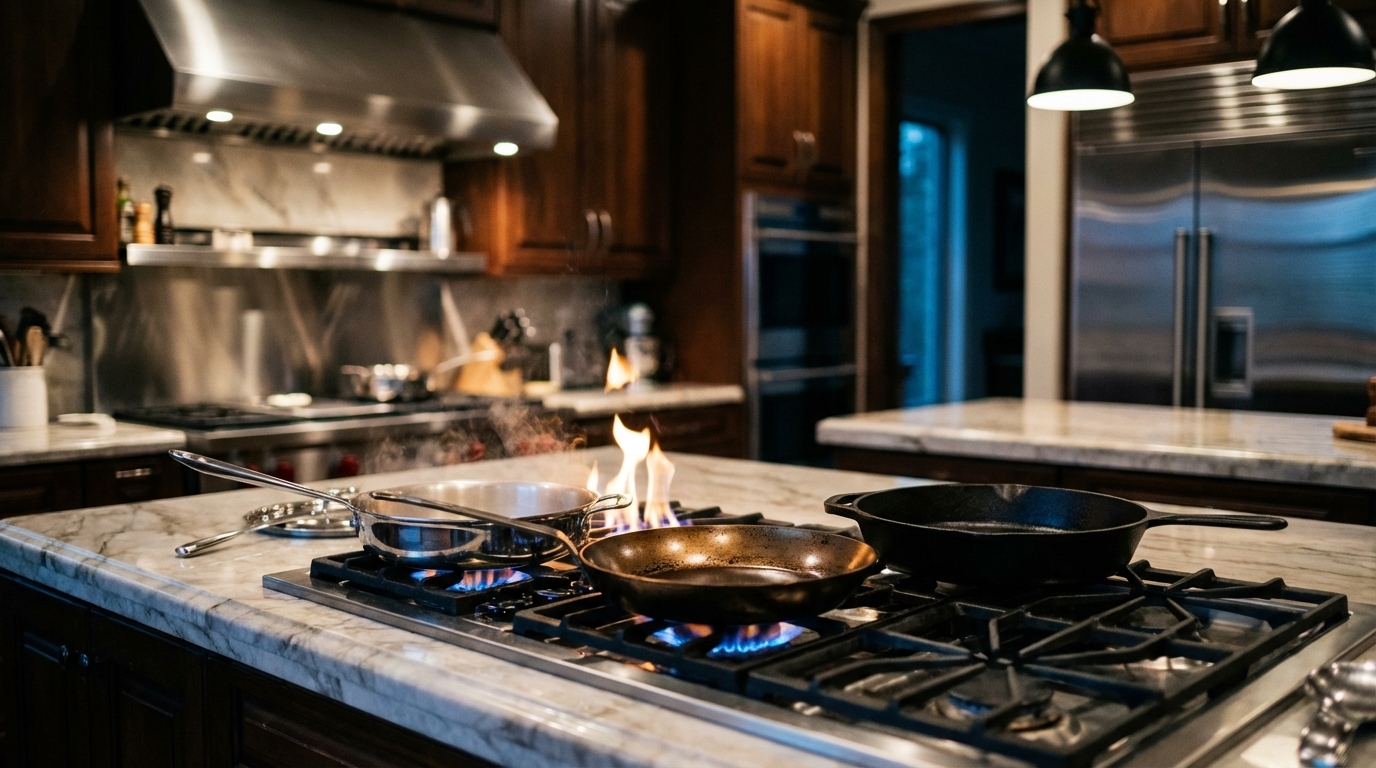
Learn to match burner type, pan size and material so every meal heats evenly and efficiently. Choose carbon steel for quick control, tri-ply stainless for steady heat, and trust proper preheating to cut energy waste and kitchen heat.
How Pan Gas Burners Transfer Heat to Your Cookware
Choose a burner slightly smaller than your pan's base and let tri-ply stainless steel do the rest--those two moves turn gas's 40 % heat waste into the even, steady sizzle that cooks your food instead of your kitchen.
Flame dynamics vs electric coils - why pan gas matters
Gas burners create direct flame contact with your cookware, but only about 40% of that heat energy actually reaches your food. [1] The rest?
It escapes around your pan, heating up your kitchen instead of your meal.
When researchers used thermal imaging on a 12-inch cast iron pan, they found something revealing--the surface stayed unevenly heated for nearly two minutes, with heat visibly escaping around the edges the entire time. [1] Compare that to induction, which generates heat directly inside the pan through electromagnetic fields, creating uniform temperatures almost instantly and heating about four times faster. [1] Understanding these efficiency gaps helps you cook smarter on gas: proper preheating and matching your burner size to your pan are your best tools for keeping heat where it belongs.
Matching pan size and material for optimal heat transfer
Getting the right match between your burner and pan size makes all the difference in how evenly your food cooks. A burner that's too small creates a hot spot in the center while the edges stay cool.
Too large? Heat creeps up the sides, wasting energy and making temperature control tricky. [3] Your best bet is to pick a burner slightly smaller than your pan's base and keep it centered--this gives you the most even heating and best control. [3] Your pan's construction matters too: tri-ply stainless steel, like our stainless steel pan, distributes heat more evenly across the entire base compared to single-layer options. [3] This even heat distribution becomes especially important when you can't get that perfect burner-to-pan match.
Choosing the Right Misen Pan for Gas Stoves
Pick your Misen pan like a pro: grab carbon steel when you need lightning-fast heat tweaks for searing, aluminum-core stainless when you want even heat for sauces, and cast iron when you're counting on steady, hold-heat-for-days braises.
Material picks: carbon steel, aluminum‑core stainless, and cast iron
Carbon steel heats fast and responds immediately when you adjust the flame, perfect for high-heat searing, quick stir-fries, and wok-style cooking where control matters. Our carbon steel pan develops a natural nonstick surface over time while handling gas burner temperatures that would damage other materials.
Aluminum-core stainless steel spreads heat evenly across the base, compensating for those hot spots gas flames create right at the center--ideal for sauce reduction, browning, and any task where consistent temperature prevents scorching. Cast iron holds heat like nothing else, maintaining steady temperatures for pan-frying chicken or braising short ribs, though you'll need extra preheat time to get that mass of metal up to temperature.
Match each material to what you're cooking: carbon steel for responsive heat control, stainless for even heating, cast iron for heat retention.
Practical Gas‑Cooking Techniques with Misen Pans
Keep your Misen pans thriving on gas by seasoning carbon steel and cast-iron after each use, flash-drying over a low flame, and giving stainless a quick deglaze and monthly polish to outsmart rust and rainbow stains.
Seasoning, maintenance, and daily care to extend pan life
Gas burners' high heat and direct flames make proper maintenance especially important for extending pan life. Carbon steel and cast iron need regular seasoning--heating thin oil layers into the metal creates a protective, non-stick surface that handles gas flame contact better than bare metal. After cooking, rinse while warm (not hot), dry immediately over your gas burner's low flame for 30 seconds, then wipe with neutral oil.
This quick routine prevents the rust that gas cooking's temperature swings can accelerate. Stainless steel handles differently: deglaze immediately after cooking to prevent protein buildup from gas hot spots, and polish monthly with Bar Keepers Friend to remove the rainbow discoloration gas flames leave on steel.
Skip extended soaking for all materials--water damages seasoning layers and can separate bonded steel layers.
When Electric or Induction Makes Sense and How to Adapt
Switching to induction delivers custard-perfect, edge-to-edge heat and slashes energy waste, but first grab a magnet--if it doesn't cling to your pan, you'll need ferromagnetic cookware like cast iron or multi-ply stainless to unlock the upgrade.
Even heat distribution on induction and coil tops
Induction generates heat directly within the cookware through electromagnetic fields, creating uniform temperatures across the entire pan base--a stark contrast to the uneven heating patterns discussed earlier with gas burners. [4] Radiant coil tops transfer heat through a glass surface from metal elements below, losing roughly 30-35% of energy and creating temperature variations until the element fully heats. [4] Tasks requiring precise, even heat--like making custards or delicate sauces--benefit from induction's consistent temperature control, which holds steady even at very low settings. [5] While coil tops work with any flat-bottomed cookware, induction requires ferromagnetic materials, making your current pan collection the deciding factor in whether a burner switch needs new cookware. [4]
Adapting your Misen collection for electric ranges without compromise
Most pans designed for gas work seamlessly on electric coil tops, but induction demands ferromagnetic materials to function--pans lacking magnetic properties simply won't heat, while those with non-metallic cores may trigger erratic sensor cycling. [6] The materials discussed earlier take on new importance here: cast iron and carbon steel pans adapt across all burner types without modification, offering the most flexibility when switching between cooking surfaces. [6] Multi-ply stainless steel with thick aluminum cores spreads induction's concentrated electromagnetic field more evenly, minimizing the hot spots that single-layer construction can develop. [6] Before committing to a full cookware upgrade, test one pan on your specific induction model--different cooktops have varying sensitivity levels and power cycling patterns. [6]
- Gas burners deliver only ~40% of heat to food; the rest escapes around the pan.
- Match burner size to pan base for even heating and better energy efficiency.
- Carbon steel responds fastest to flame changes; cast iron retains heat longest.
- Season carbon steel and cast iron after each use to protect against rust from gas flames.
- Induction heats four times faster and more evenly than gas via electromagnetic fields.
- Induction requires ferromagnetic pans; coil tops work with any flat-bottom cookware.
- Cast iron and carbon steel pans work on all burner types without modification.
- https://www.linkedin.com/pulse/gas-versus-induction-heat-distribution-marc-brune-pe-gl3nc
- https://www.solidteknics.com/blog/the-easy-guide-to-matching-your-pan-to-your-burner/?srsltid=AfmBOoqTrvSr9SgGa79h_2lUUBTm6EbsUROXZ7xE6FxHtNaOAqr2fvl_
- https://imarku.net/blogs/news/whats-the-best-cookware-for-gas-stoves?srsltid=AfmBOor8_mGbIeRuMJloiPbrn8kpH2341AyQFv2P2hUodELpUWlBYTZY
- https://www.whirlpool.com/blog/kitchen/induction-vs-electric-cooktop.html
- https://www.nytimes.com/wirecutter/reviews/is-an-induction-stove-for-you/
- https://www.reddit.com/r/Cooking/comments/1cmlsic/cooking_set_for_induction_stove/