

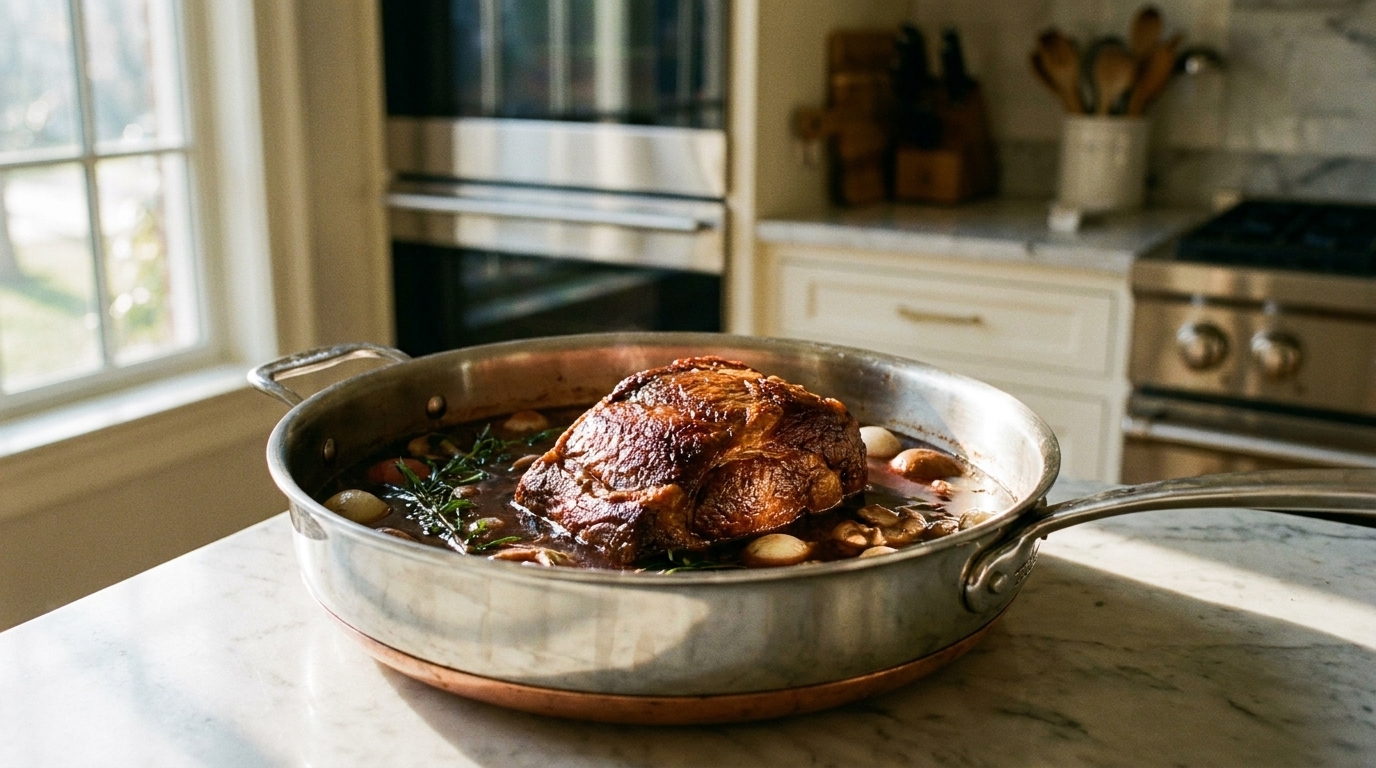
A rondeau's wide, shallow design excels at searing proteins without crowding while maintaining precise temperature control for braises, stews, and grain dishes. Master the geometry and heat distribution that make this pan essential for building deep flavor and consistent results across eight classic meals.
What Is a Rondeau and Why It's Essential for Home Cooks
A rondeau's wide, shallow design lets you sear proteins without crowding, then braise gently in the same pan without switching cookware.
How a Rondeau Differs from a Saucepan, Saucier, and Stock Pot
A rondeau's defining feature is its wide, flat base and shallow walls -- a shape that sets it apart from every other pot in your kitchen.[1] A saucepan uses tall sides and a narrower base to keep liquid concentrated and promote reduction, making it best for sauces and smaller quantities of liquid.[1] A saucier takes that concept further with sloped, curved walls that make whisking easier but reduce usable cooking surface.[2] A stock pot goes the opposite direction -- tall, with a smaller diameter -- built for large volumes of liquid where surface area doesn't matter.[1] The rondeau lands between all three: wide enough to sear without crowding, and shallow enough to let moisture escape during braising.[1]
Why Shallow, Wide Sides Make a Rondeau Perfect for Braising and Simmering
Braising depends on two competing forces -- browning first, then gentle moisture retention -- and the rondeau handles both without switching pans. Its wide base creates the surface area needed for the Maillard reaction, allowing moisture to evaporate quickly during the initial sear so food browns rather than steams [3].
Once liquid is added, the shallow walls keep food partially submerged without fully covering it, which concentrates flavor as the braise reduces [4]. That same shallow depth makes it easier to monitor and adjust liquid levels during a long simmer -- something a taller pot makes significantly harder to gauge [4].
8 Meals That Showcase a Rondeau's Versatility: From Braises to Stews
A rondeau's wide, shallow base excels at searing proteins and simmering braises and grains evenly without the heat spikes that occur in taller pots.
Beef Bourguignon and Coq au Vin: Slow-Cooked Braises That Demand Even Heat Distribution
Both beef bourguignon and coq au vin follow the same structural sequence: sear the protein, build aromatics in the fond, deglaze with wine, then simmer partially covered until collagen converts to gelatin.
A rondeau handles every stage in one vessel -- its wide base browns chicken or beef without crowding, which prevents steaming and keeps the Maillard crust intact before liquid is added. [6] The even heat distribution then maintains the gentle, consistent simmer both dishes require, preventing the heat surges that can shred connective tissue before collagen fully converts. [5] That temperature stability is harder to achieve in a Dutch oven, where thicker walls and taller sides can trap heat and spike the simmer unexpectedly during a long braise. [5]
Risotto, Paella, and One-Pot Grains: Why Wide Surfaces Reduce Stirring and Prevent Sticking
Risotto, paella, and one-pot grain dishes all benefit from a wide, shallow cooking surface that keeps ingredients in a thin, even layer.
For paella, rice should sit no more than a finger's width deep in the pan -- and once added to the broth, you stop stirring entirely. [7] A wider diameter allows heat and liquid to circulate across every grain evenly, which is what builds the socarrat (the crispy bottom crust) without scorching the edges. [7] The rondeau's broad, flat base delivers that same geometry, keeping grain dishes from sticking or cooking unevenly the way they would in a taller, narrower pot.
Rondeau Cooking Techniques: Searing, Simmering, and Shallow Frying
A rondeau's wide, flat base and five-ply construction deliver even heat and consistent browning for searing, while its shallow depth gives you precise control during long, low-temperature braises.
Building Flavor Through Browning: How Rondeau Design Maximizes Surface Contact
The Maillard reaction requires direct, sustained contact between food and a hot surface -- and the rondeau's wide, flat base, typically 10 to 12 inches across, gives you enough room to sear proteins without crowding, preventing the steaming that blocks browning. [8] Five-ply construction distributes heat more evenly across that surface than tri-ply alternatives, producing consistent golden crusts rather than pale patches where the pan ran cool. [8] Preheating the empty pan over medium-low heat for 90 seconds before adding oil gives the metal time to stabilize, so food sears on contact rather than releasing moisture first. [5] Both the geometry and even heat retention make a rondeau more reliable at building deep color than narrower pots with the same capacity. [9]
Maintaining Temperature Control: Depth and Lid Fit for Consistent Cooking Results
The rondeau's shallow depth contributes directly to temperature consistency during long cooks -- less liquid volume means the pot responds faster to heat adjustments, giving you tighter control over simmer intensity without overcorrecting. [5] A lid that fits flush with the pan's straight walls maintains near-100% relative humidity inside without building pressure, keeping moisture circulating rather than escaping during a braise. [5] That combination holds the interior at the sustained 85-90 degreesC range where collagen converts to gelatin most efficiently, preventing the heat spikes that shred meat before connective tissue fully breaks down. [5] A tight-fitting lid also matters when transitioning from stovetop to oven -- it locks in moisture consistently across both environments, so the braise continues uninterrupted without adjusting technique or adding liquid back mid-cook. [10]
Choosing and Maintaining Your Rondeau for Years of Reliable Cooking
Stainless steel rondeaus need hand washing and gentle care to avoid warping and surface damage that shortens their lifespan.
Stainless Steel vs. Enameled Cast Iron: Material Comparison for Different Cooking StylesThe choice between stainless steel and enameled cast iron comes down to how you cook.
Multi-ply clad stainless responds faster to heat adjustments and tolerates high-heat searing without enamel damage risks from metal utensils or sudden temperature changes. [11] Enameled cast iron's higher thermal mass holds temperature longer, making it better suited to long, gentle braises -- but the coating needs more careful handling to stay intact over time. [12] For multi-hour acidic dishes, enameled cast iron also resists flavor transfer better than bare stainless steel. [11] Our cast iron vs. stainless steel comparison breaks down these tradeoffs across more cooking scenarios.
Essential Care Tips to Preserve Your Rondeau's Performance and Appearance
Stainless steel rondeaus need hand washing rather than the dishwasher -- repeated cycles degrade the pan's surface over time. [13] For everyday residue, warm soapy water and a soft sponge handle most cleanup; for scorched bottoms, boil water in the pan and scrape gently with a wooden spoon until the stuck bits release. [13] Avoid wire brushes and cooking sprays -- abrasives scratch the surface, while sprays polymerize onto the metal and resist normal cleaning. [14] Always let the pan cool to room temperature before washing, since thermal shock from cold water on a hot pan can warp the base over time. [13] Our step-by-step stainless steel cleaning guide covers discoloration, calcium deposits, and heat tint removal in detail.
- A rondeau's wide, flat base and shallow walls make it ideal for both searing and braising in a single pan.
- The rondeau's geometry lets moisture evaporate during browning while keeping food partially submerged during gentle simmering.
- Five-ply stainless steel distributes heat more evenly than tri-ply, producing consistent golden crusts without pale spots.
- A tight-fitting lid maintains 85-90 degreesC during braising, the optimal range for converting collagen to gelatin without overcooking.
- Stainless steel rondeaus respond faster to heat adjustments; enameled cast iron holds temperature longer for extended braises.
- Hand wash stainless steel with warm soapy water; avoid dishwashers, wire brushes, and cooking sprays to preserve the surface.
- https://www.seriouseats.com/gift-guide-essential-pots-and-pans-presents-for-home-cooks
- https://www.centurylife.org/pick-one-straight-vs-curved-saucepan-saucier-sauteuse-sidewalls/
- https://brass-steel.com/blogs/tips-and-guides/pots-vs-pans-key-differences-for-better-cooking?srsltid=AfmBOoptsUCivbfen4Epv6Ak5UJtLKMt_B306h9t7m0CVeXNKhw6CExl
- https://www.thespruceeats.com/best-braising-pans-5080036
- https://lifetips.alibaba.com/kitchen-hacks/why-you-need-a-rondeau-in-your-kitchen
- https://www.foodnetwork.com/recipes/anne-burrell/coq-au-vin-recipe-2012206
- https://www.seriouseats.com/best-paella-pans-8424588
- https://www.seriouseats.com/why-you-need-a-rondeau-in-your-kitchen-7483540
- https://www.chefstop.ca/blogs/guides/brazier-vs-rondeau-vs-stock-pot-choosing-the-right-pan-for-your-kitchen?srsltid=AfmBOopSR9UFZ_ij_Dpf1N9GKP4FfRds_Z05pg5ltO7YnO469md28LK2
- https://cookswarehouse.com/braisers-rondeaus/?srsltid=AfmBOool7wHVr3FBKuS_uG_ltA4qepe8xRHblecE5Xj4h9K8PLOUwjRF
- https://www.centurylife.org/how-to-choose-cookware/
- https://clankitchen.com/rondeau-pan/
- https://madeincookware.ca/blogs/care/how-to-cook-with-stainless-steel-cookware
- https://www.debuyer-usa.com/blogs/guides/choosing-your-champion-cast-iron-vs-stainless-steel?srsltid=AfmBOoqsrIccJryAjhAE6g2cenYkxxkUmCDmby91799BwxAs3uPrjob0