

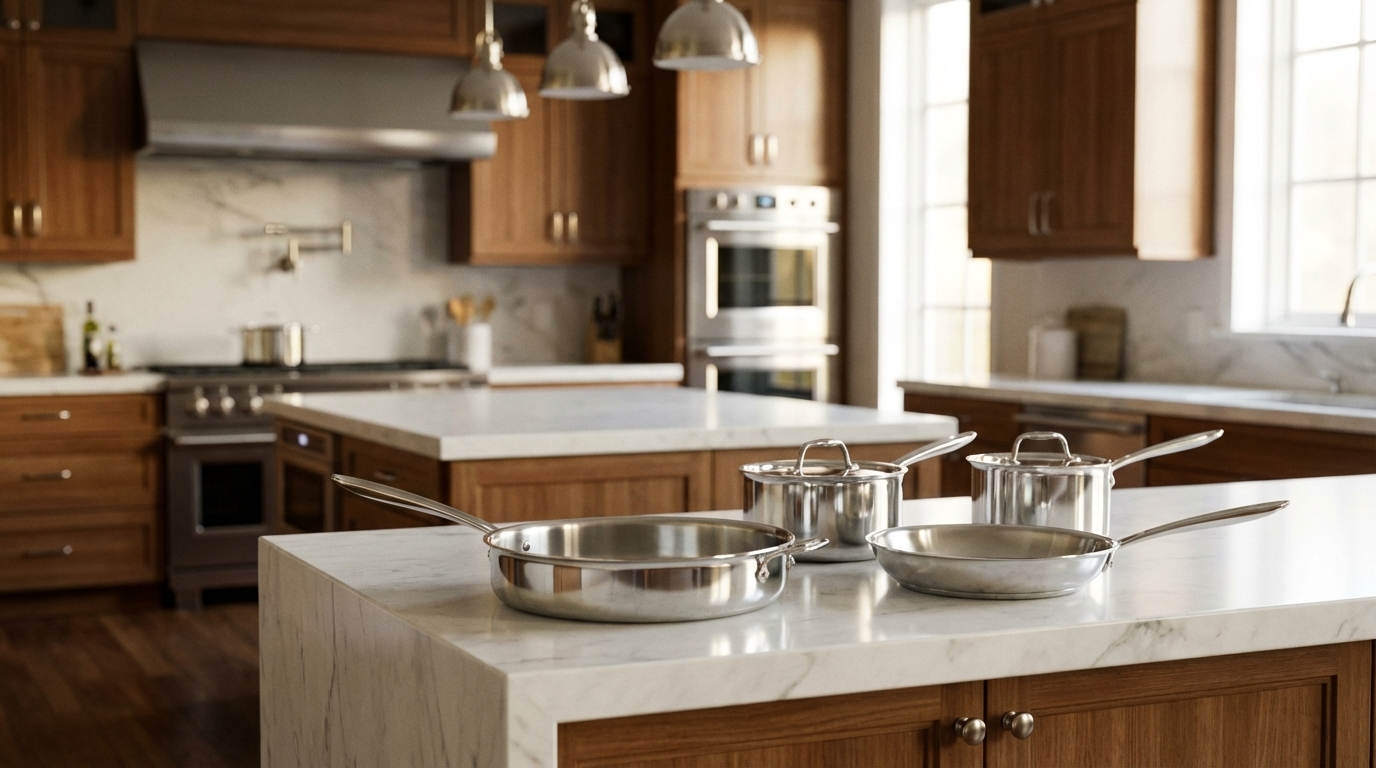
A quality stainless-steel pan is the last skillet you'll ever need to buy--this guide shows you how to turn its decades-long lifespan into flawless, restaurant-level meals while slashing kitchen waste and cost. You'll master the science of heat: preheat until a water bead dances, then trust the surface to grip and self-release proteins for picture-perfect sears and rich, caramelized fond that becomes instant pan sauces. Daily care is simple: hand-wash with mild soap, dry immediately to prevent mineral spots, and let baking soda and vinegar handle any stubborn bits instead of harsh chemicals that dull the finish. When accidents happen--burnt layers, rainbow heat tint, or white film--you'll learn chef-tested fixes like lemon-baking soda scrubs or a quick Bar Keepers Friend polish to restore mirror-bright steel without scratching. The article also teaches you to spot when a loose handle can be tightened or when deep scratches and separating layers signal it's time to recycle, ensuring your cookware stays safe and high-performing for 10-20 years of everyday cooking. By the end you'll cook greener, save money, and confidently reach for the same pan whether you're frying eggs, searing steak, or deglazing a week-night pan sauce--no non-stick required.
Why Stainless Steel Pans Are a Smart, Sustainable Choice
Invest once in a virtually indestructible stainless steel pan and you'll cook with pro-level heat control for 10-20 years while keeping a stack of short-lived non-stick pans out of landfills and cutting your kitchen equipment costs by a fifth.
Durability and performance benefits of stainless steel pans
Here's the thing about stainless steel pans: they're practically indestructible. While other cookware wears out after a few years, a quality stainless steel pan can last decades with proper care, shrugging off rust, dents, and daily abuse [1].
Yes, they cost more upfront, but that investment pays off when you're still using the same pan 20 years later. The secret to stainless steel's cooking performance?
It's all in the construction. Quality pans with tri-ply or multi-ply designs distribute heat evenly and respond quickly to temperature changes, delivering professional-grade results for home cooks
How proper care of stainless steel pans cuts waste and saves money
Taking care of your stainless steel isn't just about keeping it pretty--it's about making a smart, sustainable choice. With proper maintenance (which we'll cover in detail later), these pans easily last 10-20 years, sometimes longer [5]. Compare that to non-stick pans that need replacing every few years, and the math becomes clear. Restaurant data backs this up: kitchens using quality stainless steel see equipment costs drop by 20% over five years [5].
Why? Because well-maintained stainless steel keeps performing like new. The heat distribution stays consistent, the non-reactive surface remains intact, and you avoid the warping and damage that sends other pans to the trash [4]. Think about it this way: every stainless steel pan you properly maintain keeps multiple disposable pans out of landfills [5].
You get consistent cooking results for decades while making a real impact on waste reduction [4]. That's what we mean by smart and sustainable--great performance that lasts, with less environmental impact.

Mastering Heat and Technique with Stainless Steel Pans
Let the pan's microscopic pores be your guide--when your protein releases on its own, that's the exact moment to flip and unlock the caramelized fond that transforms into restaurant-quality pan sauces.
Temperature control tricks for searing, sautéing, and deglazing with stainless steel pans
Here's the key to mastering stainless steel: it's all about understanding how heat changes your pan's surface. At a microscopic level, stainless steel has tiny pores that contract when heated [6]. This explains why proteins sometimes stick, then suddenly release on their own. When you add food to a preheated stainless steel pan, the temperature drops and those pores widen, gripping the food.
As the pan reheats, the pores narrow again and naturally release your protein--that's your cue to flip [6]. Don't force it; let the pan tell you when it's ready. This temperature dance creates something special: fond, those caramelized bits stuck to the pan that pack incredible flavor. After searing, add liquid while the pan's still hot to deglaze--scraping up all that golden goodness to create restaurant-quality pan sauces.
Only stainless steel gives you this advantage since nonstick pans can't develop fond [6]. The trick is maintaining steady heat throughout cooking. Once you understand this simple principle, you'll nail perfect sears every time.
Daily Care: Simple Cleaning and Storage Habits
Hand-wash your stainless-steel pans with mild soap, dry them immediately to stop mineral spots, and keep them out of the dishwasher so they stay mirror-bright and pit-free for decades.
Everyday cleaning: hand wash vs. dishwasher and safe cleaning agents for stainless steel pans Here's the truth about cleaning your stainless steel: while quality pans can handle the dishwasher, hand washing keeps them looking and performing their best [7]. The dishwasher's high heat (55-70 degreesC) and harsh detergents can gradually damage that protective layer that makes stainless steel so durable [8]. You'll notice this damage as dulling, rainbow marks, water spots, or even tiny pits forming over time [7]. If you do use the dishwasher, save it for your simplest pieces--no wooden handles, copper bottoms, or exposed aluminum [7]. Choose gentle detergents, place pans handle-down in the lower rack, and keep them separated from other metals to prevent reactions [7]. For daily cleaning, here's what works best: Let your pan cool first, then wash with warm water and mild dish soap using a soft sponge [9].
Skip the steel wool--it'll scratch the surface. For stuck-on food, a quick soak loosens things right up [9]. Your two best friends for everyday cleaning? Baking soda and white vinegar. For stubborn spots, make a paste with baking soda and water, then gently scrub with a soft cloth [9]. Vinegar cuts through water spots and brings back that shine--no harsh chemicals needed [9].
Just remember to avoid anything with bleach or chlorine, which can damage your pan's protective surface [7]. The final step makes all the difference: dry your stainless steel cookware immediately. Those annoying water spots? They're just minerals from tap water that dry on the surface [7].
Drying, storing, and preventing water spots to keep stainless steel pans looking new
Drying your pans right after washing is the secret to keeping them spotless. Those water spots that drive you crazy? They're just minerals left behind when water evaporates [10]. If you already have spots, no worries--dampen the pan and scrub gently with a baking soda-sprinkled sponge [10].
For that stubborn white chalky buildup (common in hard water areas), try this trick: mix 3 parts water to 1 part vinegar, heat it in the pan until it's almost boiling, then let it work its magic on those deposits [11]. Rinse well and you're back to shiny. Quick drying tips that actually work: - Use a cloth towel, not paper towels (no lint, no streaks) [12] - Dry completely before storing to prevent spot formation - Stack pans with protectors to avoid scratches Here's the thing about air drying--it's not the enemy some make it out to be [12]. Just wipe away excess water first.
What really matters is not letting water sit on the surface for hours, slowly leaving those mineral deposits behind [12]. A quick towel dry after washing keeps your pans looking like new.


Tackling Tough Stains and Extending Pan Longevity
Restore your stained, burnt stainless steel pan to like-new condition with chef-style deglazing, a lemon-baking soda scrub, or a single swipe of Bar Keepers Friend--and keep it cooking for another decade instead of buying new.
Removing burnt‑on food, rainbow stains, and discoloration from stainless steel pans
Stainless steel pans inevitably develop three common issues: burnt-on food, rainbow discoloration, and stubborn stains. For burnt food, the deglazing technique mimics what chefs do when making sauces--add water to the still-warm pan and heat until the stuck bits loosen [13]. For tougher burnt residue, make a paste with baking soda and water, apply to the affected areas, and let sit for 15-20 minutes before scrubbing with a non-abrasive sponge [13].
Those distinctive rainbow stains (heat discoloration) respond well to acidic treatments. Apply a mixture of baking soda sprinkled on a cut lemon, then scrub the stained surface--the acid in the lemon combines with baking soda to create a reaction that lifts these oxidation marks [13]. For particularly stubborn discoloration, Bar Keepers Friend Cookware Cleanser & Polish outperforms other options with minimal effort--stains visibly dissolve after just one or two scrubs [14].
When paired with steel wool (safe for stainless but not for non-stick or enameled surfaces), this combination restores even heavily stained pots to like-new condition [14]. For those preferring household ingredients, the baking soda and lemon combination proves effective against moderate stains while providing the added benefits of a pleasant scent and eco-friendly cleaning solution [14]. This approach works particularly well on lighter discoloration, though it requires more effort than commercial products for heavily stained cookware [14].
Repair, restoration, and knowing when to replace your stainless steel pans
Quality stainless steel pans can last 10-20 years with proper care, making repair and restoration worthwhile for minor issues [15]. Assess your pan for fixable problems versus replacement indicators. Loose handles can often be tightened with the appropriate screwdriver, extending your pan's useful life. For minor warping, some pans can be flattened by applying gentle, even pressure while the pan is warm--though this works best for slight distortions only.
When evaluating repair options, consider the cost effectiveness; repairs make sense for high-quality cookware but rarely for budget options [16]. Clear replacement indicators include deep scratches that expose inner layers (potentially leaching metals into food), significant warping that prevents even cooking, rust formation (indicating compromised stainless steel integrity), and separated layers in multi-ply pans [15]. These issues compromise both safety and cooking performance. Multi-ply pans with separating layers develop particularly dangerous sharp edges that cannot be effectively repaired [15].
Pan lifespan varies significantly based on quality--premium 18/10 stainless steel with fully-clad construction typically offers the longest service life [15]. Professional kitchens see accelerated wear, with stainless steel lasting only 5-10 years under intense use, compared to 10-20 years in home kitchens [16]. Construction details matter significantly: fully-sealed rims prevent moisture infiltration and subsequent layer separation, while thicker pans resist warping that thinner options cannot withstand [15]. Monitoring your cookware for these issues ensures you maintain safe, effective cooking tools while maximizing your investment.
- Quality stainless steel pans last 10-20 years, cutting landfill waste vs. 3-year non-stick cycles
- Hand-wash with mild soap; dishwasher heat dulls finish and risks pitting over time
- Preheat until food releases naturally--proteins stick, then free when pores contract
- Deglaze hot pan to lift flavorful fond for sauces; non-stick can't create these browned bits
- Burnt residue loosens with hot water deglaze or baking-soda paste; never use steel wool routinely
- Rainbow heat stains vanish with lemon-juice scrub or Bar Keepers Friend and non-abrasive pad
- Replace pans that show deep scratches, layer separation, rust, or warping that ruins even heating
- https://chopchopusa.com/blogs/news/pros-and-cons-of-stainless-steel-cookware
- https://stahlkitchens.com/blogs/news/benefits-of-stainless-steel?srsltid=AfmBOoqdMOBpvPuid9qdXVfc3VFcItKOrf7eHcFZDK_c7tTxjwOlG8AQ
- https://www.chefs-resources.com/stainless-steel-cookware-pros-and-cons/
- https://www.unifiedalloys.com/blog/stainless-environmental-benefits
- https://www.zhenneng.com/blog/the-health-benefits-of-cooking-with-stainless-steel-cookware
- https://www.heritagesteel.us/pages/cooking-techniques?srsltid=AfmBOooccG7taX_rYlxBKOHWerh6Puh_CYkWqA6mTz2k9Ux-iPdz_yTy
- https://ozkleen.com/dishwasher-or-handwash-how-to-clean-stainless-steel-pots-pans/
- https://metalux.in/blogs/news/dishwasher-vs-hand-wash-ensuring-cookware-safety?srsltid=AfmBOooMToMLNLU4VVIPk4h1TwG8-wvh0uu0gGWgYoTPmMD6jWr8vTm-
- https://www.blackmoorhome.co.uk/blog/the-ultimate-guide-to-cleaning-stainless-steel-cookware/
- https://food52.com/story/15027-our-guide-for-caring-for-cleaning-stainless-steel-pans
- https://www.hydroviv.com/blogs/water-smarts/chalky-residue-stainless-steel?srsltid=AfmBOooyPpUf2aX7IuKgFUItOPx3G5st0-5CR7y92sRmJiRRnhnH8oT4
- https://www.reddit.com/r/Cooking/comments/126appe/how_to_dry_stainless_steel_pans/
- https://www.armandhammer.com/en/articles/how-to-clean-a-burnt-pan
- https://www.thekitchn.com/best-method-cleaning-discolored-stainless-steel-cookware-23186094
- https://chopchopusa.com/blogs/news/how-long-do-stainless-steel-pans-last
- https://www.zhenneng.com/blog/how-often-should-you-replace-stainless-steel-cookware