

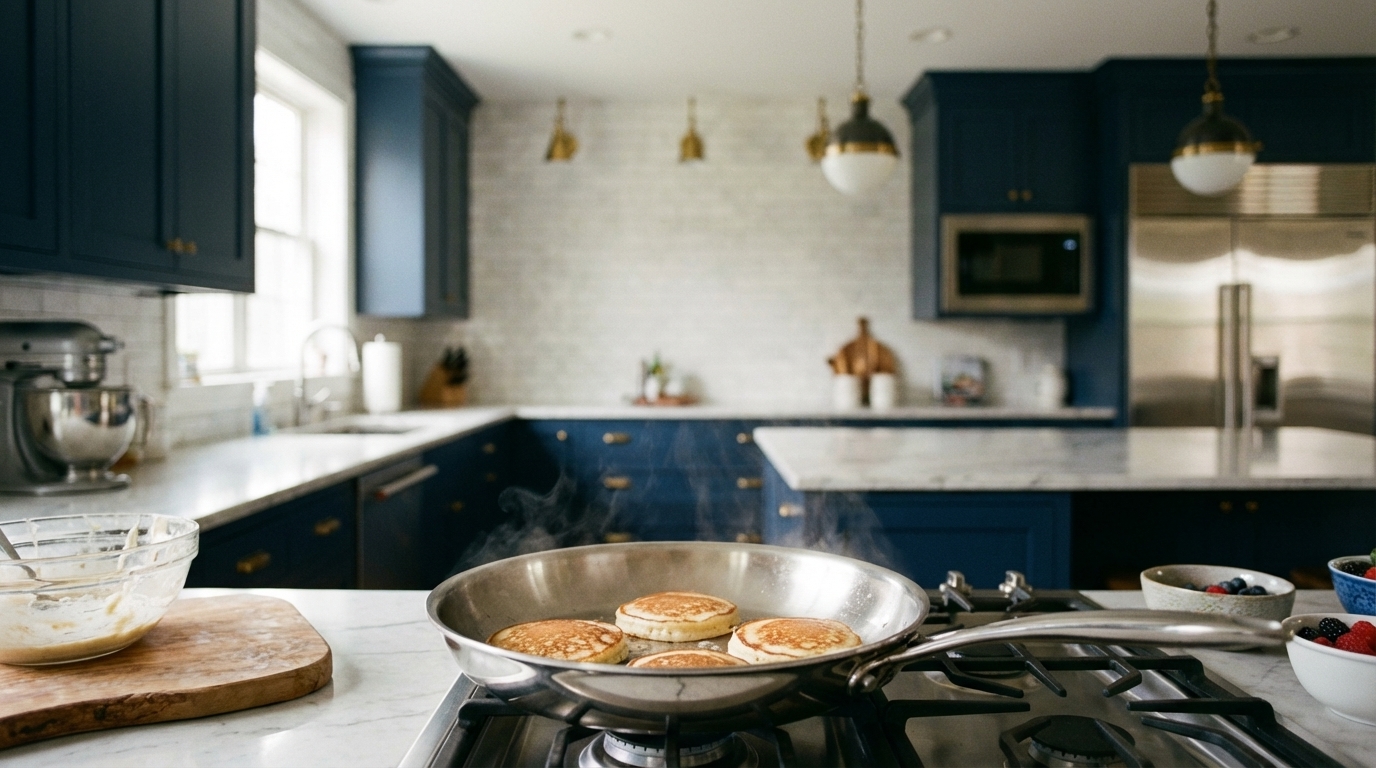
Making pancakes in stainless steel pans requires understanding the cookware's unique properties and mastering proper preheating, fat application, and temperature control to achieve a perfectly golden-brown result.
Understanding Stainless Steel Pan Properties
Multi-layer stainless steel construction ensures even heat and reduces sticking challenges.
The Science Behind Stainless Steel Cooking Surfaces
Stainless steel cookware offers a perfect balance of chemical inertness and heat conductivity—two essential properties for quality cooking. Thanks to its high chromium content, stainless steel develops a protective oxide layer that prevents rusting and unwanted chemical interactions with food. Quality stainless steel pans typically use grades like 304 (18/8) or 316, containing 18% chromium with 8-10% nickel, making them highly resistant to corrosion and acidic ingredients.[1] However, stainless steel alone doesn't conduct heat efficiently. That's why premium cookware like the 5-ply stainless steel skillet features a multi-layered construction with aluminum or copper cores sandwiched between stainless steel layers. This smart design combines the non-reactive benefits of stainless steel's cooking surface with superior heat distribution from more conductive metals in the core. The thickness of this layered construction plays a significant role in performance—thicker pans retain heat better for perfect searing, while thinner ones respond more quickly to temperature adjustments.[1]
How Heat Distribution Affects Pancake Cooking
For pancakes specifically, heat distribution makes all the difference. Quality stainless steel pans with thick, multi-layered construction distribute heat much more evenly than cheaper alternatives, which often develop hot spots that cause frustrating sticking issues.[3] The key to success begins with properly preheating your pan on medium heat for about one minute. You can verify proper preheating using the water droplet test—when drops bead up and dance across the surface rather than instantly evaporating or sitting still, your pan is ready for cooking.[3] After adding fat to your preheated pan, allow 10-20 seconds for it to properly heat before introducing your batter. Timing matters when it comes to bubbles forming in your pancake batter: if bubbles appear too quickly (under 10 seconds), your pan is likely too hot; if they take more than 30 seconds to appear, the heat is too low.[3] Once cooking begins, quality stainless steel's excellent heat retention allows you to reduce heat to medium while still maintaining even cooking across the entire pancake surface.[3]
The Protein-Metal Bond: Why Foods Stick
When proteins in food interact with stainless steel surfaces, they form strong chemical bonds that can cause sticking. Research shows that proteins like bovine serum albumin (BSA) and lysozyme (LSZ) create surface complexes with metal atoms, particularly iron, in the stainless steel's protective oxide layer.[4] This protein-metal bonding occurs through both physisorption (physical absorption) and irreversible chemisorption (chemical bonding) mechanisms.[4] Different proteins interact differently with the surface—BSA typically forms a single molecular layer, while LSZ can build up multiple layers.[4] Interestingly, these interactions change the steel's surface chemistry, causing enrichment of chromium in the oxide layer as iron atoms are preferentially released.[4] Local pH changes at the surface may further promote metal release.[4]
Comparing Stainless Steel to Traditional Pancake Cookware
Each cookware material offers distinct advantages and limitations for pancake-making. Traditional nonstick pans excel due to their slick surfaces that prevent sticking, yet they cannot withstand high temperatures and tend to degrade over time.[6] Cast iron offers superior heat retention and develops a natural nonstick surface through seasoning, though it requires specific maintenance and can be heavy.[6] Carbon steel combines benefits of cast iron and stainless steel—it is lighter than cast iron, develops a nonstick patina through seasoning, and offers excellent heat conductivity, though it also requires regular maintenance.[7] While stainless steel presents challenges due to food adhesion, its quality multi-layered construction with aluminum or copper cores offers even heat distribution that minimizes sticking when proper techniques are employed.[6]
Why Pancakes Are Particularly Challenging
Intricate batter reactions and heat dynamics create unique sticking challenges for pancakes.
The Chemistry of Pancake Batter on Metal Surfaces
When pancake batter contacts a hot stainless steel surface, complex chemical changes occur, making it prone to sticking. The batter—a colloidal mixture of flour, eggs, milk, and other ingredients—transforms physically and chemically during cooking.[8] Heat causes protein denaturation, where hydrogen bonds break and proteins unravel and tangle, forming a firmer structure.[9] Simultaneously, starch molecules undergo gelatinization, thickening the batter, while the Maillard Reaction between amino acids and sugars yields the iconic golden-brown color and aroma.[8] These protein transformations, however, can lead to aggressive bonding with the metal surface, complicating the flip and potentially tearing delicate edges.[10]
Protein Adhesion and Sugar Caramelization Issues
Pancake sticking results from both protein adhesion and sugar caramelization. As batter contacts the pan, denatured proteins form strong bonds with the metal, while sugars caramelize to create a sticky residue.[11] This complex mixture demands precise temperature control, and often the first pancake serves as a "seasoning" layer that eventually eases the release of subsequent pancakes.[10][11]
Temperature Management Difficulties
Precise temperature management is critical. A pan that’s too hot burns pancakes before they cook through, while a cool pan causes stubborn sticking. Stainless steel pans typically require longer heating times than other materials, making consistent temperature regulation challenging.[12][13] Waiting for the water droplet test—a method where water beads and dances on the surface—ensures optimal readiness.[13]
The Delicate Art of Pancake Flipping in Stainless Steel
Perfect flipping hinges on timing and tactile cues. A pancake ready to flip will release effortlessly from the pan with minimal resistance when nudged by a spatula.[15] Premature attempts can tear the pancake, while waiting too long might lead to overcooked edges.[16] Gently testing the edge provides the most reliable indicator for a successful flip.[15]
Techniques for Success: Can It Actually Work?
Precise preheating, fat application, and visual cues unlock perfect pancake flipping.
Preheating Methods: The Water Droplet Test
The water droplet test is a reliable technique for ensuring the pan has reached the ideal temperature. Preheat on medium or medium-low heat for 1–2 minutes, then add a few drops of water. If the droplets bead and glide, the pan is ready; if they evaporate instantly or spatter, adjust the heat accordingly.[15][17]
Fat Selection and Application (Butter vs. Oil vs. Combinations)
The choice of fat significantly affects the outcome. Butter imparts rich flavor but burns quickly, whereas oil provides consistent heat stability. Clarified butter offers a balance of both, delivering flavor with a high smoke point. Always add fat once the pan passes the water droplet test to ensure a thin, effective coating.[13][3]
Batter Consistency Adjustments for Stainless Steel
Achieving the right batter consistency is key—thin enough to spread evenly yet thick enough to hold air bubbles. If bubbles appear too rapidly, the batter may be overly thin; if delayed, it might be too thick. Ensuring a clean pan is equally important to prevent unwanted sticking.[18]
Timing and Visual Cues for Perfect Flipping
Rather than relying strictly on time, observe visual cues such as the formation and dissipation of bubbles. Typically, the first side cooks for 2–3 minutes and the second for 1–2 minutes. Adjust heat as necessary to maintain an even, golden-brown exterior.[19]
Common Mistakes When Making Pancakes in Stainless Steel
Overheating, poor fat usage, and premature flipping are pitfalls to avoid for flawless pancakes.
Temperature Control Errors: Too Hot or Too Cold
Pancake success is highly dependent on maintaining an ideal temperature. If the pan is too cold, the leavening agents won’t activate properly; if too hot, the exterior burns before the inside cooks. Gradual, consistent preheating is essential—use the water droplet test as your guide.[20][17][21]
Fat Application Mistakes
Common errors include using excessive fat or applying it before the pan is adequately preheated. Over-application leads to a greasy surface, while premature fat addition can diminish its non-stick properties. For butter users, adding it too early or letting it brown can adversely affect texture and flavor.[15][2]
Premature Flipping: Patience is Key
Flipping too soon disrupts the formation of a proper crust, causing the pancake to tear or stick. Wait until bubbles form and subside, and the pancake releases effortlessly when tested with a spatula.[22]
Using Improper Utensils That Damage Both Pan and Pancakes
Using metal utensils on stainless steel can scratch the pan’s surface, reducing its future non-stick performance. Instead, opt for silicone, wood, or nylon utensils to protect both your cookware and pancakes.[23]
Better Alternatives for Pancake Perfection
Exploring cast iron, non-stick, and electric griddles offers diverse paths to pancake perfection.
Cast Iron: The Traditional Gold Standard
Cast iron pans offer superior heat retention and naturally develop a non-stick surface through seasoning. Their consistent heat distribution and ability to form a perfect crust make them ideal for pancakes, despite requiring more maintenance.[25]
Non-Stick Pans: Convenience vs. Durability
Non-stick pans provide ease of use and effortless flipping thanks to their slick coatings. However, these coatings often degrade after a few years, compromising long-term durability and necessitating replacement.[26][27]
Electric Griddles and Specialized Pancake Surfaces
Electric griddles offer large, uniformly heated surfaces that eliminate hot spots, enabling the simultaneous cooking of multiple pancakes. Many advanced models feature adjustable temperature controls to ensure even golden-browning throughout.[28][29]
Side-by-Side Comparison: Stainless Steel vs. Alternatives
While stainless steel pans boast durability and rapid heat responsiveness through multi-layered design, cast iron remains unmatched for heat retention and natural non-stick properties. Non-stick options and electric griddles offer convenience but may sacrifice longevity and traditional textures.[30][31]
- Quality stainless steel cookware with multi-layered construction provides even heat distribution, but requires mastering the water droplet test to achieve the ideal cooking temperature.
- Protein-metal bonding is the primary cause of pancake sticking—allowing pancakes to set properly helps them release naturally.
- Fat selection and timing are crucial: clarified butter offers the best balance of flavor and heat stability.
- Recognizing visual cues, rather than relying solely on time, is key to achieving the perfect flip.
- While stainless steel can produce excellent pancakes with proper technique, cast iron remains the gold standard in natural non-stick performance.
- https://www.cupindy.com/blogs/info/stainless-steel-grades-cookware?srsltid=AfmBOopLva0xGshd0oZ4A3SWpWCFvJ0iMV_71ksM8szuUvZLHEo-claB
- https://www.reddit.com/r/cookingforbeginners/comments/biu4mi/how_do_you_cook_pancakes_on_stainless_steel/
- https://madeincookware.com/blogs/cooking-with-stainless-steel
- https://pmc.ncbi.nlm.nih.gov/articles/PMC3620448/
- https://www.sciencedirect.com/science/article/abs/pii/S0927776503001802
- https://www.curated.com/journal/2974000/stainless-steel-vs-nonstick-pans-which-are-better-for-you?srsltid=AfmBOopZjYesIfbNA_bj1vQ8wfJ-fez3p6HzgjWUUiidBmn2mIALBPIa
- https://debuyer-usa.com/blogs/guides/carbon-steel-vs-stainless-steel-pans-which-is-best?srsltid=AfmBOor184d_g146yk4po-2q8vnQPHGNPGNEWpaZYhPrmTGOOjvMC3Cx
- https://www.osc.org/the-science-of-flapjacks/
- https://www.quora.com/As-things-heat-up-they-go-from-solid-to-liquid-to-gas-Whats-up-with-pancake-batter
- https://www.bigblogofgardening.com/foods-to-never-cook-in-stainless-steel-cookware/
- https://www.reddit.com/r/cookingforbeginners/comments/16fzjm8/how_do_i_keep_pancakes_from_sticking_using_a/
- https://arugulafiles.typepad.com/the_arugula_files/2011/07/blueberry-pancakes-plus-can-you-make-pancakes-with-a-stainless-steel-pan.html
- https://www.thekitchn.com/the-best-way-to-cook-pancakes-23171469
- https://www.welcometomykitchen.net/2024/04/stainless-steel-cookware-common-problems-and-solutions.html
- https://www.foodnetwork.com/fn-dish/recipes/how-to-make-stainless-steel-nonstick
- https://www.tastingtable.com/1416816/avoid-making-pancakes-stainless-steel/
- https://www.reddit.com/r/Cooking/comments/1ibdn30/pancakes_in_stainless/
- https://www.hopeandbutterflies.com/2017/12/09/how-to-make-a-stainless-steel-pan-non-stick-non-toxic/
- https://www.quora.com/How-long-should-I-cook-each-side-of-a-pancake-Before-the-flip-you-cook-it-for-maybe-2-minutes-What-about-after-you-flip
- https://www.thewellnourishedmama.com/blog/perfect-griddle-temperature-for-making-pancakes
- https://www.all-clad.com/blog/post/cooking-on-stainless-steel-for-beginners?srsltid=AfmBOopqfKtec4rZJA1ixxSiIaMl8Kun4Q_XdVNTSf9ofR9jcRG6LWyx
- https://circulon.uk.com/blogs/the-culinary-circle/the-ultimate-practical-guide-to-pancake-day
- https://madeincookware.com/blogs/best-utensils-for-stainless-steel-cookware
- https://www.restaurantware.com/blogs/cooking-equipment/7-essential-tools-for-making-pancakes?srsltid=AfmBOopGW4fXB77ey6rGUS5V2yS7VESRn9xXgtwrowKPbcffDeBCZg-v
- https://www.carawayhome.com/blog/cast-iron-vs-stainless-steel
- https://www.epicurious.com/expert-advice/best-nonstick-pan-to-buy-reviews-article
- https://www.curated.com/journal/3071001/an-expert-guide-to-non-stick-pans?srsltid=AfmBOoorCLRD26H1hXNDFVq_pCcDGaBxB7aCK_77LpfecP-XMwNKRtBk
- https://www.thespruceeats.com/best-electric-griddles-to-buy-4136097
- https://www.kingarthurbaking.com/blog/2023/02/20/better-pancakes
- https://www.thespruceeats.com/best-pancake-griddles-4773604
- https://www.foodandwine.com/lifestyle/kitchen/best-grill-pans