

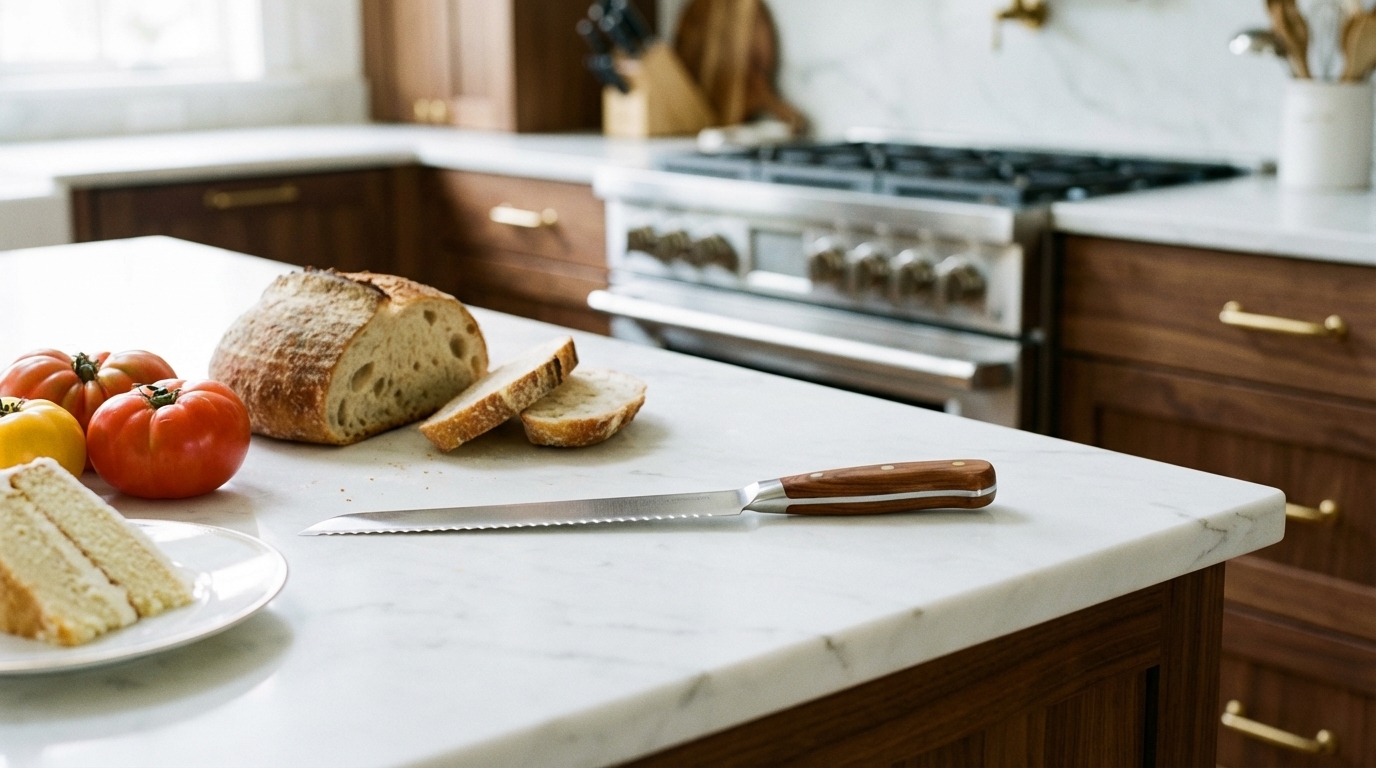
A serrated knife is the most under-appreciated everyday performer in the kitchen: its teeth bite through tough-skinned, soft-interior foods--tomatoes, citrus, cake, roasts--without crushing, while its single-bevel geometry keeps it sharp for years with only the tips touching the board. The article shows why reserving it for bread wastes its talents, when to choose it over a straight edge (cooked or slippery items) and when to avoid it (raw veg that will leak moisture), and how to keep it keen with a tapered diamond or ceramic rod worked gullet-by-gullet or--faster--by lightly stoning the flat back. Readers learn the physics behind the cut, the light sawing grip that replaces downward pressure, the storage habits that prevent chipped teeth, and the clear signals that distinguish a blade worth sharpening from one ready for retirement. Master these simple habits and a quality serrated knife becomes a daily precision tool that outlasts and often outperforms the chef's knife for the most delicate slicing tasks.
Why a Serrated Knife Deserves Daily Care
Treat your serrated knife like a daily go-to because its teeth cleanly pierce tough skins without crushing delicate insides--tomatoes, peaches, roast--and only the tips touch the board, so it stays sharp longer than any straight blade.
Understanding the unique edge geometry
A serrated blade works differently than your chef's knife. While a straight edge pushes through food, serrated teeth bite and saw, concentrating pressure on fewer contact points -- making quick work of tough crusts and fibrous materials. [1] The blade has two key parts: the teeth that grip and cut, plus the gullets (those curved spaces between teeth) that clear food as you slice. [2] This design is why your serrated knife stays sharp longer -- only the tooth tips touch the cutting board during normal use, so the edge wears down much more slowly than a straight blade.
Here's what makes sharpening tricky: serrated knives are typically ground on one side only, with the beveled face angled between 13 degrees and 17 degrees. [2] The back stays flat. This single-bevel design means you can't sharpen it like other knives -- standard sharpening stones would just grind down the teeth instead of refining them.
Understanding this geometry helps you maintain the knife properly, which we'll cover in detail later.
Benefits beyond bread slicing
Yes, serrated knives excel at slicing bread -- but limiting them to the bread board means missing out on what they do best. The real strength of a quality serrated knife lies in handling any food with contrasting textures: tough outside, delicate inside. Think tomatoes.
A straight edge compresses the skin before breaking through, crushing the flesh beneath. Serrations pierce cleanly on contact -- no pressure, no mess. [3] The same principle applies whether you're slicing ripe peaches, portioning a layered cake, or carving through a crispy-skinned roast. [3] The key insight? Any time you face that tough-exterior, soft-interior challenge, reach for your serrated blade.
We'll explore specific techniques for different foods in the next section, but remember this rule: if pressing down would damage what you're cutting, let the serrations do the work instead.

Everyday Uses: From Veggies to Delicate Tasks
Reserve your serrated knife for cooked vegetables, soft pastries, and citrus--where its teeth grip slippery surfaces and slice without crushing--while keeping raw vegetables crisp by using a straight blade instead.
Slicing steamed broccoli and other vegetables
Using a serrated knife on raw vegetables comes with a real tradeoff worth understanding before you reach for it. The tearing motion of the teeth damages cell walls, which causes the cut surface to release more moisture than a straight edge would. [4] On raw vegetables headed for a hot pan, that extra liquid means sogginess -- the water that keeps a vegetable firm ends up in your dish instead. [4] Steamed broccoli sidesteps this problem entirely.
Because it's already cooked and served immediately, preserving cellular integrity doesn't matter the way it does pre-cook. What does matter is getting through the soft, yielding florets and thicker stalks without compression -- and here, the serrated edge's ability to handle soft materials without crushing them becomes relevant. [5] The same applies to other cooked vegetables with textural contrast, like roasted cauliflower or grilled corn cut from the cob, where the exterior has firmed or charred while the interior remains tender.
For raw vegetables, though, a sharp straight blade will consistently produce cleaner cuts with less cell damage -- the serrated knife is best reserved for after the heat has already done its work. [4]
Cutting soft fruits, pastries, and more
Where the serrated edge earns its keep with soft fruits and pastries isn't just in the cut itself -- it's in the grip.
Citrus rinds and glazed pastry surfaces are naturally slippery, and a straight blade trying to initiate a cut on either tends to skate before it bites. [6] The teeth catch and hold the surface immediately, so the blade goes where you place it rather than sliding toward your hand. [7] That same grip is what makes slicing cake layers so clean: rather than pressing down and compressing the sponge, you use a light sawing motion and let the teeth do the work, keeping each layer intact without tearing the crumb structure. [6] For citrus specifically, the teeth move through the pith -- which resists compression -- without requiring the downward force that would otherwise crush the segments underneath. [7] The practical upshot is that with soft fruits and pastries, technique matters as much as sharpness: keep pressure light and let the sawing motion carry the blade through, rather than pushing down the way you would with a chef's knife.
Maintaining Sharpness: Practical Sharpening Tips
Swap your pull-through sharpener for a tapered diamond rod and slip it--gullet by gullet--along the beveled face with three light passes to keep serrated knives truly sharp without crushing the teeth.
Choosing the right sharpening tool for a serrated knife
The tools most people already own -- pull-through sharpeners and electric wheel models -- are the wrong ones for serrated knives.
Both styles are designed to work both sides of a straight edge simultaneously, and neither can reach inside the gullets where the actual cutting surface lives. [8] What works instead is a tapered or cylindrical sharpening rod, either diamond-coated or ceramic, sized to fit the individual gullets of your specific blade.
Diamond rods cut faster and suit knives that have gone genuinely dull; ceramic rods are gentler and better suited to regular maintenance between sharpenings. [8] A dedicated sharpening system with angled ceramic rods offers a practical middle ground for home use, with diamond rods better suited for blades that have gone from dull to neglected. [9] There's also a faster alternative that bypasses the individual gullet approach entirely: working the flat, unbeveled back of the blade across a fine stone at a slightly raised angle until a small burr appears inside the serrations, then deburring with a rod or the corner of a strop. [9] This flat-back method won't preserve the points of the teeth over time, but it produces a sharp, functional edge much faster than working each gullet individually -- a reasonable tradeoff for kitchen knives used daily rather than collected. [9]
Step‑by‑step sharpening routine
Once you have the right rod in hand, execution comes down to a few consistent habits. Start by identifying the beveled face of the blade -- the side with the angled grind -- since all sharpening pressure goes there, not on the flat back. [10] Place the tip of the rod into the first gullet at the heel of the knife, matching the rod's diameter as closely as possible to the curve of that individual serration.
Keeping the rod angled to match the original bevel -- as discussed in the edge geometry section above -- draw it from heel to tip along that single gullet using light, controlled strokes rather than force. [11] Three to five passes per gullet is usually enough for routine maintenance; a genuinely dull knife may need a few more before you feel the edge catch. Work each gullet individually down the full length of the blade, resetting the rod angle each time, since serration sizes can vary slightly even on the same knife. [10] After finishing the beveled side, flip the knife and lay it flat -- or nearly flat -- and make one or two light passes along the back with a fine ceramic rod or the edge of a leather strop to remove the small wire burr that builds up during sharpening. [11] Skipping that deburring step leaves a ragged edge that tears rather than cuts, which defeats the point of the whole process.
For those who prefer professional results without the learning curve, mail-in knife sharpening services handle serrated blades with the same care and precision.


Extending Lifespan: Storage, Care, and Replacement
Protect your serrated knife's delicate teeth with snug plastic edge guards or wall-mounted magnetic strips, skip dishwashers and knife blocks, and replace--not resharpen--when teeth chip or lose bite after sharpening.
Proper storage to protect the serrated edge
All that careful sharpening work? It's wasted if your knife goes back into a cluttered drawer. Those serrated teeth are more delicate than you might think -- when they knock against other metal utensils, they chip and flatten faster than any cutting task ever could. [12] If you're storing knives in a drawer, hard plastic edge guards with felt lining work beautifully. They stop blade-on-blade contact, cushion against the tiny wear from daily drawer use, and keep your knife from sliding around. [14] Here's a pro tip: measure your blade before buying.
A loose-fitting guard defeats the purpose -- you want it snug enough that the blade stays put. [14] Magnetic strips mounted to wall studs are ideal -- your knives hang in open air with zero contact points. Just skip the adhesive mounting. Trust us, discovering your knives on the floor at 2 AM isn't how you want to learn that lesson. [14] Those traditional knife blocks? They're actually tough on serrated edges.
Every time you slide the blade in or out, those slots wear down the teeth -- it's like bad sharpening technique in slow motion. [13] Whatever storage you choose, here's the golden rule: no dishwashers. Between the harsh detergent, intense heat, and all that jostling with other utensils, you're looking at the fastest way to wreck both the teeth and handle. [12]
When to re‑sharpen versus replace
Knowing when to sharpen versus replace is actually pretty straightforward. Since only the tooth tips touch your cutting board, serrated blades outlast straight-edge knives by years -- even with daily use, a good bread knife keeps its edge remarkably well. [15] When your knife gradually loses its bite but the teeth look intact, go ahead and sharpen it. But if you see bent, chipped, or broken teeth?
That's replacement territory. Sharpening refines an edge -- it can't rebuild missing steel. [16] Another telltale sign: if your freshly sharpened knife goes back to tearing and crushing within a week, that's fatigued steel talking. No amount of maintenance fixes a material problem. [15] For most home cooks using their serrated knife daily, expect five to ten solid years before these issues crop up. [15] At that point, the math gets simple: professional serrated blade sharpening costs nearly as much as a new quality knife.
If you're looking for a hassle-free option, our [16] Bottom line? Judge by performance, not years. When a freshly sharpened blade still tears your bread instead of slicing cleanly, it's time for a new knife. [16]
- Serrated knives stay sharp longer because only tooth tips contact the board.
- Use serrated blades for tough-exterior/soft-interior foods like tomatoes or cake.
- Sharpen with a tapered rod matching each gullet's curve, not pull-through devices.
- Store in edge guards or on magnetic strips; knife blocks and dishwashers damage teeth.
- Raw vegetables cut with serrated knives lose more moisture and turn soggy when cooked.
- When teeth are chipped or a fresh sharpen dulls in a week, replace the knife.
- Expect 5-10 years of daily use before a quality serrated knife needs replacement.
- https://ganzoknife.com/blog/knife-edge-types-straight-serrated-and-partially-serrated/
- https://bpsknives.com/features-of-sharpening-serrated-knives/?srsltid=AfmBOopzaUHyw4hfUNc0Wk7env5pupy0nbjZj3lTsVhU19x_7A0lwkB4
- https://sharpedgeshop.com/blogs/knife-types/the-essential-uses-of-a-serrated-knife-a-complete-guide?srsltid=AfmBOooqNRS5yJYxbcDArDwi8O5Wc4KgecNkAPRppJs8t1gfCbwOtNBe
- https://www.reddit.com/r/Cooking/comments/6018na/why_shouldnt_i_use_serrated_knives_to_cut/
- https://www.knifeart.com/plainbyjoeta.html
- https://nogentknives.com/when-to-use-a-serrated-knife-tips-from-nogent/
- https://www.shanzuchef.com/en-us/blogs/chief-blog/serrated-knife-101-everhything-you-need-to-know?srsltid=AfmBOopSqz_Kf1rH0i6SMY8vbcwfjV-Es8saM_zw2PA3lKuOq8XMXnZd
- https://www.consumerreports.org/home-garden/kitchen-knives/how-to-choose-a-knife-sharpener-a2076237033/
- https://www.reddit.com/r/sharpening/comments/1drsprg/best_tools_for_serrated_sharpening/
- https://lifebymikeg.com/blogs/all/easy-guide-how-to-sharpen-a-serrated-bread-knife-at-home
- https://www.shanzuchef.com/en-us/blogs/chief-blog/the-ultimate-guide-to-serrated-knives-and-how-to-sharpen-them-en?srsltid=AfmBOop0phWl7SXDLR9KQb7oz80PyuV_aPeYVbNb6ZiYA6Pdbz40A_-_
- https://prochefkitchentools.com/blogs/tips/knife-storage-for-serrated-blades
- https://www.webstaurantstore.com/blog/5088/how-to-store-knives.html?srsltid=AfmBOooSjF6f-5mQFzhV5YojFojKolMotdW_UIP-LbtTtEekMJr-lT8l
- https://www.epicurious.com/expert-advice/this-knife-protector-changed-my-knife-storage-game-for-the-better-article
- https://www.knifesharpening.sg/blog/when-should-you-replace-your-knives
- https://sharper-tools.com/when-your-serrated-knife-just-needs-to-be-retired/