

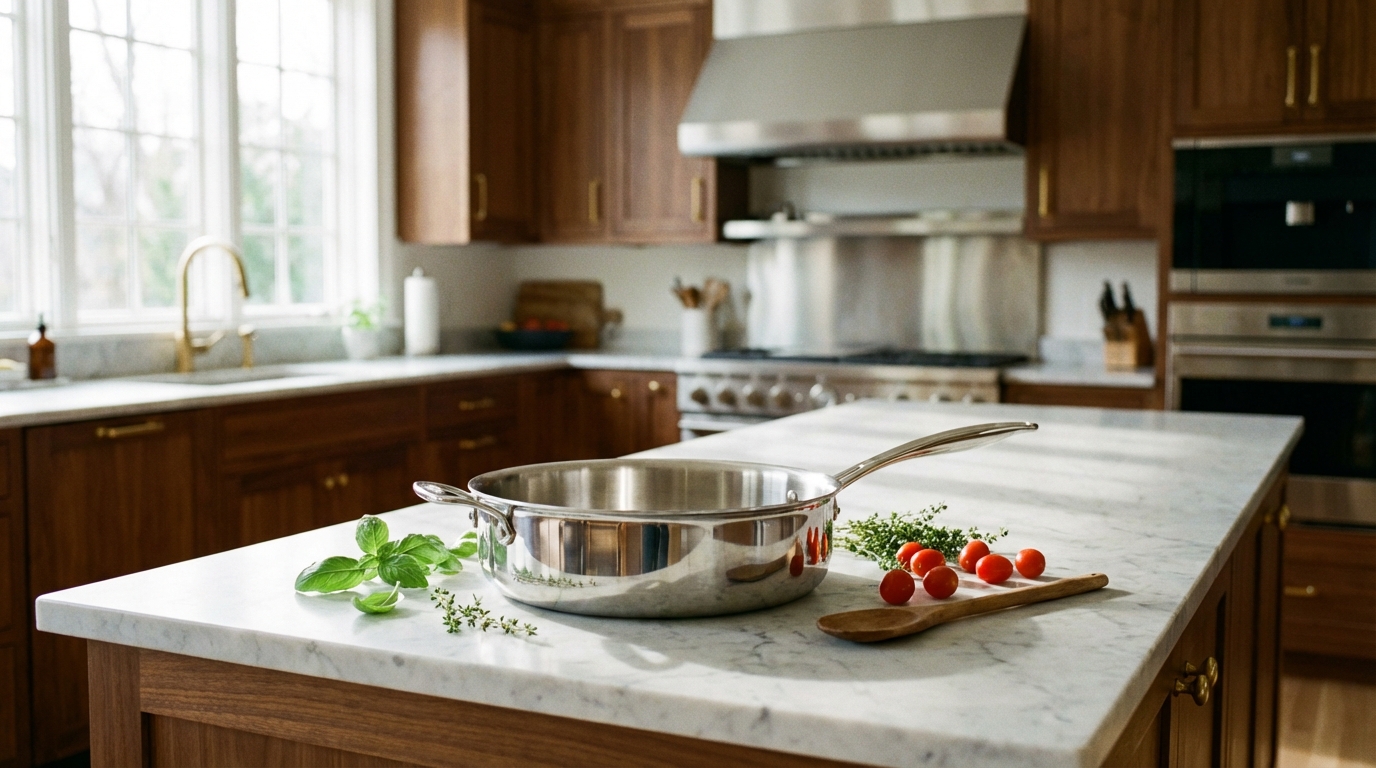
A truly safe, non-toxic deep sauté pan is the kitchen workhorse you didn't know you needed--spacious enough to hold a family-size stir-fry, deep enough to simmer a curry without splatter, and engineered to keep questionable coatings out of your food. The article walks you through the science behind "no-nasties" cookware, explaining why certified PFOA- and PTFE-free ceramics, anodized aluminum, and fully-clad stainless steel are the gold standards for even heating and toxin-free cooking. It demystifies size math (a 12-inch, 3.5-inch-deep sauté equals roughly four quarts of usable volume) so you can pick the pan that actually fits your burner and your weeknight chili batch, then pairs material choice to cooking style--lightweight aluminum for quick veggie sears, heavier steel for slow, even reductions. Care instructions are distilled into three habits: low-to-medium heat, nylon or wood tools, and hand-drying to prevent warping and preserve the surface, adding years to your investment while keeping meals worry-free.
Why a non toxic deep sauté pan matters
Ditch the PFAS-laden non-stick: ceramic pans let you sear without toxic fumes while cutting the forever-chemicals already in 95 % of Americans' blood.
Health benefits of eliminating PFAS and PTFE
Here's what you need to know: most non-stick pans use PTFE (that's the coating in Teflon). Even during normal cooking, PTFE releases gases and chemicals--some mild, some serious. But the bigger issue is PFOA, a PFAS chemical used to make PTFE.
These chemicals stick around forever. They build up in your body, your food, and the environment. [1] The health effects are real and documented. Studies show PFAS can weaken your immune system, raise cholesterol, mess with your thyroid and liver, and increase cancer risk.
Last year, the WHO officially classified PFOA as a human carcinogen. Here's the kicker: over 95% of Americans already have PFAS in their blood from decades of exposure through cookware, packaging, water, and household dust. [2] When PFOA got banned, manufacturers just switched to alternatives like GenX--which researchers think might be just as bad. [3] That's why avoiding these chemicals altogether makes more sense than waiting for the next replacement to get banned. Stanford Medicine researchers put it simply: switching to non-PFAS cookware is one of the easiest ways to cut your daily exposure. [2] If you've got kids at home, this matters even more--their developing bodies are more sensitive to these chemicals. [1] That's why we focus on ceramic-coated cookware that skips the PFAS entirely (more on the technical details in our coating section below).
Impact on flavor and cooking performance
PTFE's temperature limits don't just affect safety--they limit what you can actually cook. Teflon starts releasing dangerous fumes at 570 degreesF, which means you can't properly sear meat or build the kind of fond that makes great pan sauces. That high-heat cooking is what creates the Maillard reaction--the chemistry behind those deep, caramelized flavors we all love. [4] Ceramic pans handle the heat without breaking a sweat.
Lab tests prove ceramic keeps its smooth surface even under intense temperatures, while PTFE coatings start breaking down. Your food releases cleanly, even when you're pushing temps for a serious sear. [4] Here's why that matters for your cooking: when coatings degrade unevenly, you get hot spots and sticking that throw off your heat control. You can't brown food properly when half your pan is too hot and the other half isn't hot enough.
With ceramic, you can sear, scramble, and pan-roast at whatever temperature your recipe needs--no fumes, no coating failure, just consistent results. [4]

Key features to look for in a safe deep sauté pan
Choose a PTFE-free ceramic-coated, 4-5-quart deep sauté pan with a helper handle and published third-party safety tests to avoid hidden PFAS and handle heavy, multi-task cooking without spillover or wrist strain.
Ceramic, PFAS‑free coating basics
Ceramic coatings are built through a sol-gel process: silica, metal oxides, and binders get sprayed onto a metal base--usually anodized aluminum, cast iron, or stainless steel--then fired between 400 degreesF and 800 degreesF. The result is a glass-like, hard surface that requires no fluorochemicals to release food.
That's the structural difference that matters: PTFE needs PFAS chemistry to function, ceramic doesn't. Consumer Reports tested two ceramic pans against 96 PFAS compounds and found none in either. [5] The same test found 16 PFAS compounds in a PTFE pan labeled "PFOA-free," with combined levels hitting 703 ppb in one sample. [5] That gap explains why label reading is consequential when shopping.
"PFOA-free" on a PTFE-coated pan tells you little--PFOA can still appear as a manufacturing byproduct, and the remaining PFAS go unaddressed. "PTFE-free" paired with a ceramic coating is the more reliable claim, because ceramics are primarily silicon dioxide and metal oxides, not PTFE or any PFAS variant. [5] One caveat worth knowing: because sol-gel coating formulas are often proprietary, some ceramic pans may contain organic polymers or metal oxide nanoparticles whose long-term behavior under heat is still being studied. [6] If a brand publishes third-party testing or NSF certification covering PFOA, cadmium, and lead, that transparency is worth factoring into your choice. [6]
Essential design elements: depth, helper handle, induction compatibility
Beyond coating chemistry, three physical design choices determine how much you can actually do with a deep sauté pan day-to-day. Depth is the most consequential.
A pan with at least 4-5 quarts of capacity handles frying, sautéing, steaming, and boiling without spillover--tasks that a standard skillet can't manage safely because the walls aren't tall enough to contain liquid or hot oil. [7] A helper handle--the small secondary grip opposite the main handle--becomes essential once the pan is full. A loaded 5-quart pan is heavy enough to strain a single wrist, and a helper handle lets you lift and transfer with both hands, which also keeps you further from the heat source. [8] Food & Wine testers specifically noted helper handles as a design advantage in their induction cookware evaluations, citing better control during high-heat cooking. [8] Induction compatibility is the third element worth confirming before you buy.
Induction cooktops generate heat through a magnetic field, so only pans with a magnetic base--typically a bonded steel disc on an aluminum body--will work. Aluminum and ceramic alone won't respond to the magnetic field; the steel layer is what activates heating. [8] Most brands that build for induction say so explicitly in product descriptions, but if you're unsure, a magnet held to the base of the pan gives you a quick answer. [8]
How to choose the right size and material for everyday cooking
Match your pan's size to the number of people you're feeding, then rotate ceramic for delicate foods, stainless or cast iron for high-heat searing, and replace ceramic once scratches appear--usually within one to three years.
Matching capacity to your cooking style
Choosing the right size pan is straightforward once you know what questions to ask.
Start with how many people you're cooking for.
A
Material choices that stay non‑toxic over time
Every cookware material has its own timeline, and understanding these differences helps you make smarter choices. Ceramic-coated pans offer the easiest non-stick experience but need replacing most often. With regular use, you'll get one to three years of reliable performance--closer to one or two years if you're cooking daily at high temperatures. [11] When you notice scratches or worn spots, it's time for a new pan. Damaged ceramic can shed particles into your food, which defeats the purpose of choosing non-toxic cookware. [12] Stainless steel takes the opposite approach: invest once, use forever.
Quality 5-ply pans built with 304 stainless steel (18/10 grade) lock aluminum between protective layers, preventing any leaching concerns. [13] The catch? This grade contains nickel, which some people need to avoid. If that's you, look for 430 stainless steel (18/0)--nickel-free but less resistant to corrosion over time. [13] Cast iron stands apart from both options. With proper seasoning and care, these pans actually improve with age, building up a natural non-stick surface through decades of use.
No coatings to fail, no timelines to track. [11] Smart cooks often keep multiple materials on hand. Use ceramic for morning eggs and delicate fish, then reach for stainless steel or cast iron when it's time to sear steaks. This rotation extends each pan's life while avoiding overexposure to any single material--a practical approach that makes your cookware investment last longer. [12]


Caring for your non toxic deep sauté pan to last longer
Protect your ceramic pan's non-stick magic for years by cooling it before washing, skipping metal tools and aerosol sprays, and giving it a quick hand-wash with a soft sponge.
Proper cleaning and maintenance routines
Taking care of your ceramic-coated pan is simpler than you might think--it really comes down to avoiding two things: sudden temperature changes and scratches. Let your pan cool completely before washing it. I know it's tempting to rinse that hot pan right away, but the thermal shock from cold water can crack the coating and even warp the base. [14] For daily cleaning, stick with hand washing using a soft sponge and regular dish soap.
Even if the label says "dishwasher-safe," those high-alkaline detergents and heat cycles will wear down your coating faster than gentle hand washing. [15] Got stuck-on food? A 10-15 minute soak in warm water usually does the trick--but don't leave it overnight. Extended soaking actually weakens the non-stick surface over time. [15] For stubborn stains, make a paste with baking soda and water, then gently rub with a soft cloth.
If you notice discoloration from regular high-heat cooking, try this: simmer a mix of water and white vinegar in the pan for a few minutes. It lifts those surface stains without harming the ceramic coating. [15]
Tips to preserve non‑stick performance without waste
Your cooking habits make all the difference in how long your pan stays non-stick. Start each cooking session with a small amount of butter or neutral oil like soybean--this thin layer actually helps maintain the ceramic's release properties. [16] Skip the aerosol cooking sprays completely. They leave behind a sticky film that bonds to the coating and builds up over time, making your pan less non-stick with each use. [17] Same goes for olive oil at high heat--it tends to burn on rather than cook off cleanly. [16] Stick with wood, silicone, or nylon utensils to protect that ceramic surface.
Metal tools create tiny scratches that expose the layer beneath, and once that happens, your non-stick performance won't come back no matter how well you clean it. [16] When storing your pans, place a soft cloth or pan protector between them--even gentle contact during storage can wear down the coating over time. [17] Here's something most people don't know: if your pan starts sticking, it might not be permanently damaged. Often it's just a buildup of invisible residue. Try rubbing the surface with a damp Magic Eraser or some coarse salt--this can strip away that film and bring back the non-stick performance. [16] It's definitely worth trying before you toss the pan and buy a new one.
After all, replacing cookware prematurely is both expensive and wasteful when a simple fix might do the trick. Taking care of your cookware is just one part of maintaining a well-functioning kitchen. Just like you'd maintain your knife sharpening routine to keep your blades in top shape, these simple habits will help your ceramic pan perform its best for years to come.
Conclusion
- Choose non-toxic, PFAS-free coatings to avoid chemical leaching at high heat.
- Opt for 4-6 qt capacity and 3-inch sides for versatile sautéing and simmering.
- Stainless steel, cast iron, or ceramic interiors are safest for daily cooking.
- Match pan diameter to burner size; 10-12 in. suits most home stovetops.
- Hand-wash with mild detergent and avoid metal utensils to extend coating life.
- Preheat on medium, then add oil to reduce sticking and preserve surface.
- https://www.epa.gov/pfas/our-current-understanding-human-health-and-environmental-risks-pfas
- https://med.stanford.edu/news/insights/2024/07/pfas-forever-chemicals-health-risks-scientists.html
- https://pubmed.ncbi.nlm.nih.gov/28913736/
- https://www.asaicookware.com/blogs/all/ceramic-v-s-teflon-pans-heres-what-actual-science-says?srsltid=AfmBOorV3wl0_Iux58uGI8SwSf6sU-417wzyeAkkOITlvblWDhlErvhX
- https://www.consumerreports.org/toxic-chemicals-substances/you-cant-always-trust-claims-on-non-toxic-cookware-a4849321487/
- https://ceramics.org/ceramic-tech-today/ceramic-coated-cookware-safety/
- https://www.amazon.com/SENSARTE-Nonstick-Non-toxic-Induction-Compatible/dp/B0BZCTLMBF
- https://www.foodandwine.com/best-induction-cookware-8681645
- https://www.debuyer-usa.com/blogs/guides/how-to-choose-the-right-size-de-buyer-cookware-for-your-kitchen?srsltid=AfmBOooKQLnIhOqCLm5Zf29uw75uIIHKqQYfQJ9OOrSFS6AagPWgn271
- https://www.reddit.com/r/Cooking/comments/5huf1u/saute_pan_size/
- https://www.healthierhomes.com/post/what-is-the-healthiest-material-for-cookware?srsltid=AfmBOor-1o4jErtjev4VZtYZ0GuHBl8kqQ0sTeucSFJBCDPEmpeIPG4D
- https://www.wellnessdaddy.com/post/which-non-toxic-pan-is-best
- https://mamavation.com/product-investigations/safest-cookware-stainless-steel-cast-iron-ceramic-bakeware.html
- https://madeincookware.ca/blogs/news/how-to-clean-and-care-for-ceramic-pans
- https://crumble.co/blogs/articles/how-to-clean-and-maintain-ceramic-cookware?srsltid=AfmBOopb7wHJGd49LBk_1syFyeAx0BWC63Kl1nrI-3QHWPG71qVBejWx
- https://economistwritingeveryday.com/2023/06/06/how-ceramic-pans-work-and-how-to-restore-their-non-stick-coating/
- https://crumble.co/blogs/articles/how-to-clean-and-maintain-ceramic-cookware?srsltid=AfmBOorF7pTFwsp7Vwez0yzBJiNQlMZIW-yOuEu1Gc_09yj4TEfg8Re3